This post is inspired by the afternoon I spent at the Tibetan border in the north part of Langtang National Park. The space between two places is that of the Bhote Kosi river, the body of water currently separating Nepal from Tibet. That space is in the midst of being closed, and a new, Chinese-funded bridge is slowly stretching its trestles across the river. Its completion will mark the start of a new over-ground link between China and India.
I was so struck by this construction project, and its possible implications, that I scribbled this post in my Moleskine shortly after seeing it.
–
Being in Nepal has provided a thousand-and-one answers to the question I was asked countless times before I left Canada: “so, why Nepal?” But before I was provided those insights, there were a few reasons I had come up with in my mind. One of them was Nepal’s crucial positioning smack between China and India, two of the fastest developing countries in the world.
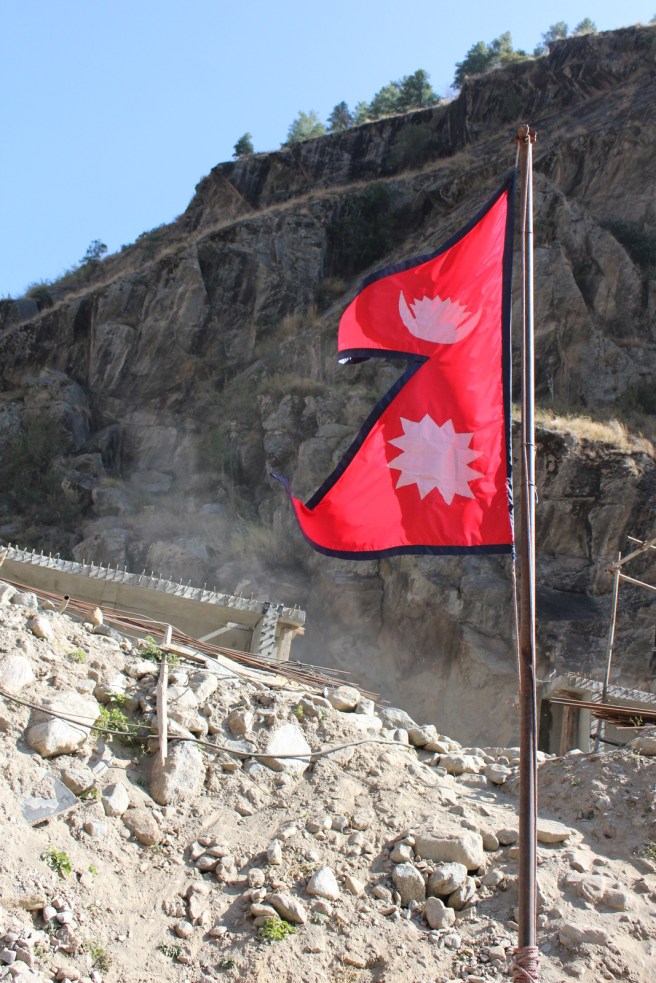
Amidst the rubble of a construction zone, a Nepali flag marks ones transition from Tibet into Nepal.
Soon to be connecting those two places is a road: a new, Chinese-constructed highway that spits out of Tibet and runs along the Bhote Kosi river, It runs past the homes of Tibetan refugees, and will connect the country with another road that leads deep through the heart of Nepal, branching off further still onto roads that eventually lead to India.
The current suspension bridge connecting Nepal and Tibet (left); a traditional Tamang village, just down road from the new bridge (right)
Now, the final stage in that project is being completed. The space between two places is soon to be no more. Another new piece of Chinese infrastructure is being constructed, this time in the form of a stoic concrete building and bridge, one that will link the new highway with Tibet, once and for all.
The contrast between the border sides is dramatic. On the Nepali side, it’s a construction zone. Colourful Tata trucks line the road, and construction workers in red helmets hammer away industriously. The place where this is all happening is particularly significant in the sense that it was somewhere important before this construction zone dictated it as so. It’s called Rasuwa, and it’s a century-old historical site representing the remains of what was once a defence fort when Nepal and Tibet weren’t so close. Now it’s a meeting of old and new in the most literal sense. The original stone walls of Rasuwa are overshadowed by the cold structures on the other side of the Bhote Kosi.
I’m perturbed by what all this could mean for Nepal. Certainly it means more income, as drivers will be required to transport goods, and that will likely create all sorts of spin-off for secondary businesses here. But still, historical heritage is being destroyed on a whim for the construction of this bridge – what does that mean in terms of future negligence? To strike the essential balance between progress and past, is anyone asking these questions?
Maybe I’m wrong to be bothered so much by this space between two places. This space that is getting smaller, in this world that keeps connecting, without much thought for how and why and at what cost.
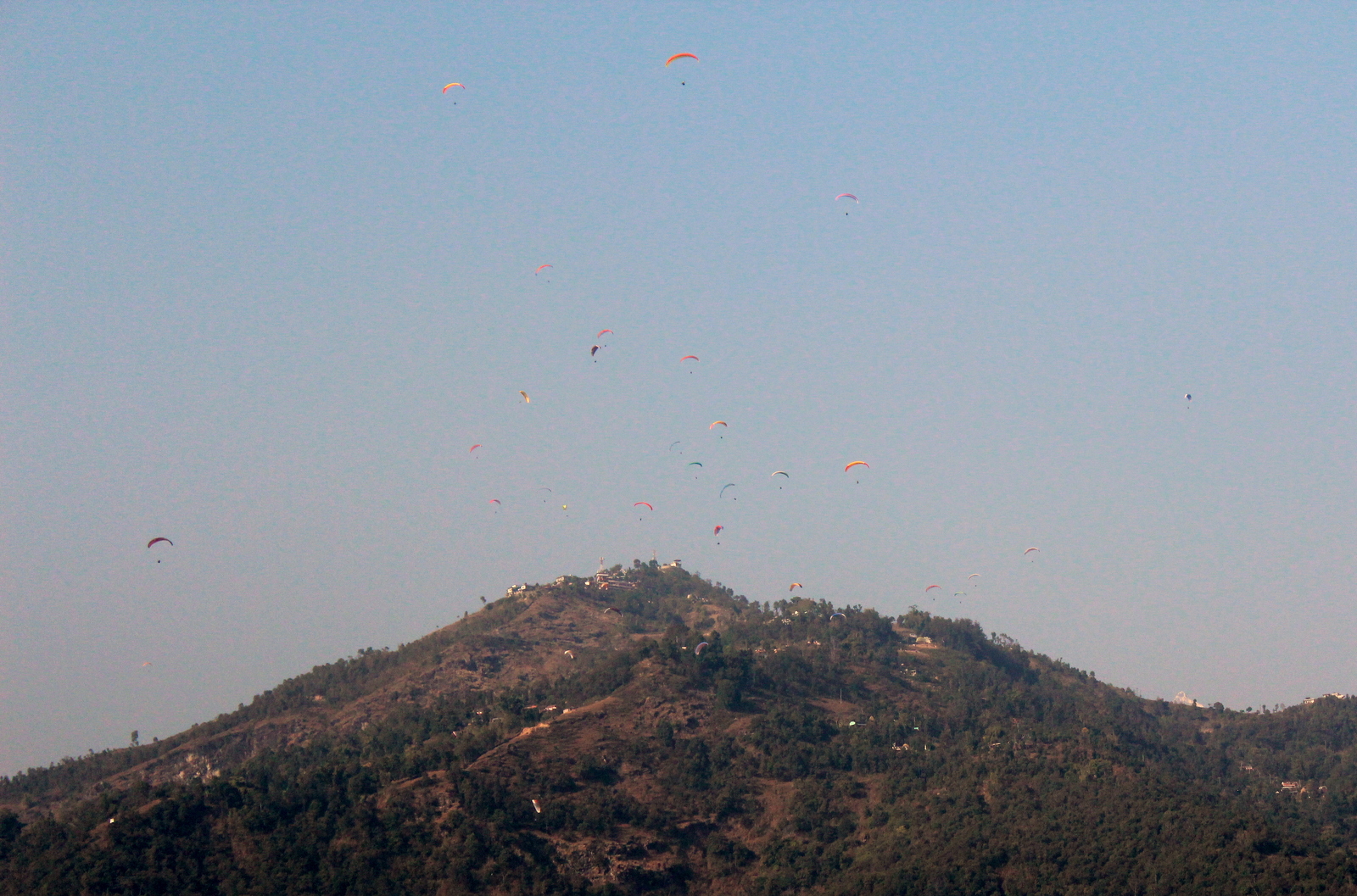
If you look high over the hills to the north of Pokhara, you see what appear to be dozens of birds of prey. Swooping and drifting in the wind, they’re like vultures circling the terrain below. It’s only upon closer inspection you notice the colourful parachutes and arched openness of what can only be a group of paragliders.
On Monday morning, one of them was me.
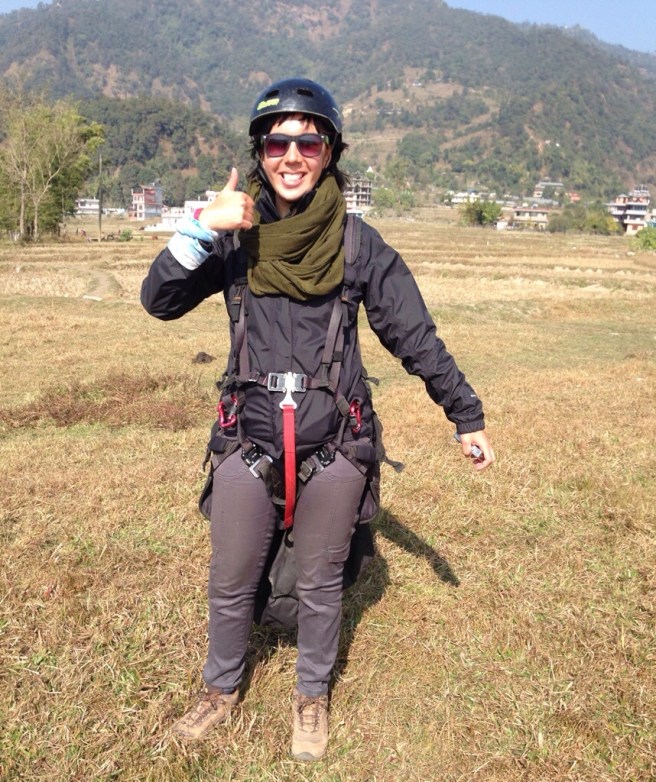
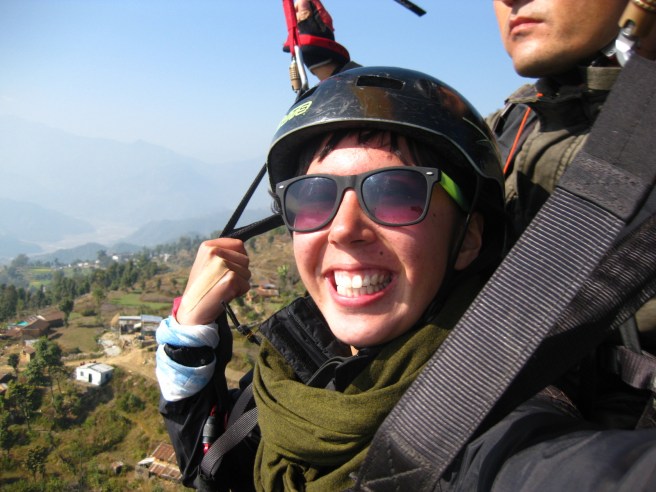
Here I am! This was technically taken after landing, but you get the gist of it..
I’d read about paragliding opportunities all over Nepal, but Pokhara seemed like the right place at the right time. I’d met a handful of fellow travellers who had paraglided here, and they had all told me about the awesome feeling that comes with soaring amongst the Annapurna Himalayan Range. It doesn’t hurt that Pokhara is listed as one of the best places on the planet to paraglide, either.
So I signed up for flight: December 30 at 11:30 a.m. Nearing the end of 2013, I figured it was good to round off the year with a new and exciting experience.
At shortly after 11 a.m. that day, myself and three other paragliders made our way up to the launching area in the back of a large jeep. The views of the mountains and down onto the sprawling reaches of Pokhara were stunning from the open back of the jeep, and I couldn’t wait to see the same sights from thousands of feet, floating freely through the Himalayan thermals.
One of my fellow paragliders, just before I took off
The paragliding trips all take off from the town of Sarangkot, 1,450 metres up. Each company has its own private take off spot, each lined up next to one another along the steep mountainside.
Sunrise Paragliding’s take off area.
My pilot, Laxman, got me buckled into the harness.
Laxman! He has been paragliding for seven years and goes up with tourists three times a day.
He then instructed me how to take off: walk, walk, walk, ruuuuuuuun! The actual take off process really didn’t last that long, and is not a hugely fear-inducing activity. Prior to my trip, I had pictured something more like the Lukla airport: a steep runway area, a fast run and a leap off a cliff. This was much more tame. After a few seconds, the wind takes over, and filled our creamsicle-coloured parachute, carrying Laxman and I up off the ground.
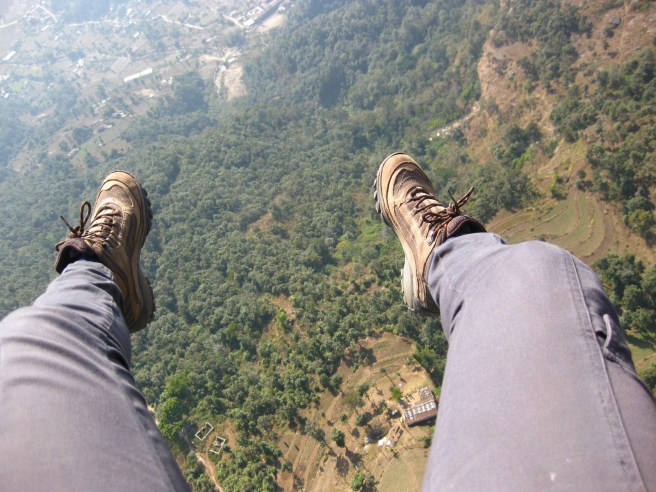
Soon we were high above the take off area, my feet dangling beneath my seat in the harness.
Long way down!
The view was spectacular. On one side, breathtaking views of the Annapurna Range: Dhaulagiri, Machapuchare and Annapurna II, lined up across the horizon, their sides only slightly obscured by a few wisps of cumulus cloud. The proximity of Pokhara to such clear Himalayan views is impressive and humbling: a toy-sized city stretched out beneath their magnitude. In the other direction was the ravishing blue of the Phewa Tal, a breeze creating a surface of sparkling diamonds. The silhouette of the World Peace Pagoda on the distant hillside; the city; the distinctive plots of nearby homes and farms. All was visible with such a sharp clarity.
The actual experience of paragliding involves a series of soft turns, following the air flow as it pushes you up and gently drives you down. The movements of the paraglider (thanks to Laxman’s expertise) are graceful and calculated.
Marlon had lent me her small point and shoot camera (with wrist strap!) for the ride, and I while up in the air I practiced the ancient Nepalese art form of the “selfie.” Maybe you’ve heard of it?
Overall, an incredible experience, and another check off my bucket list!
Until travelling to Nepal, my token bus story always involved a 17-year-old me and an overextended bathroom break at a gas station in the middle of Norway. Today I find myself with a whole slew of new stories, ones to laugh at in the moment and remember fondly once the intended destination is reached.
Please allow me to share my most recent two:
The road to Syabrubesi
It turns out my overnight bus ride from Kathmandu to Janakpur was not the most eventful, dually fearsome and exciting trip I would be having during my time in Nepal.
Syabrubesi is the start point of the Tamang Heritage Trail, that trek I did just before Christmas. When I read in Lonely Planet that the bus ride from Kathmandu to the northern town was the worst part of the Langtang region treks, I knew I was in for a treat. At just over 120 kilometres in distance, the bus ride takes a whopping seven hours (that’s just a shade over 17 km/hr, on the super deluxe speedy bus, might I add) from start to finish. But I was ready. Armed with a breakfast of rice crackers and a jar of peanut butter (guilty creature comfort), I settled into my spot in the seat behind the driver. We started off through the early morning smog, up and out of Kathmandu into the mountains. I turned my attention to admire the fading views of the valley, and twisted the lid back onto my peanut butter jar.
WHAM! SMASH!
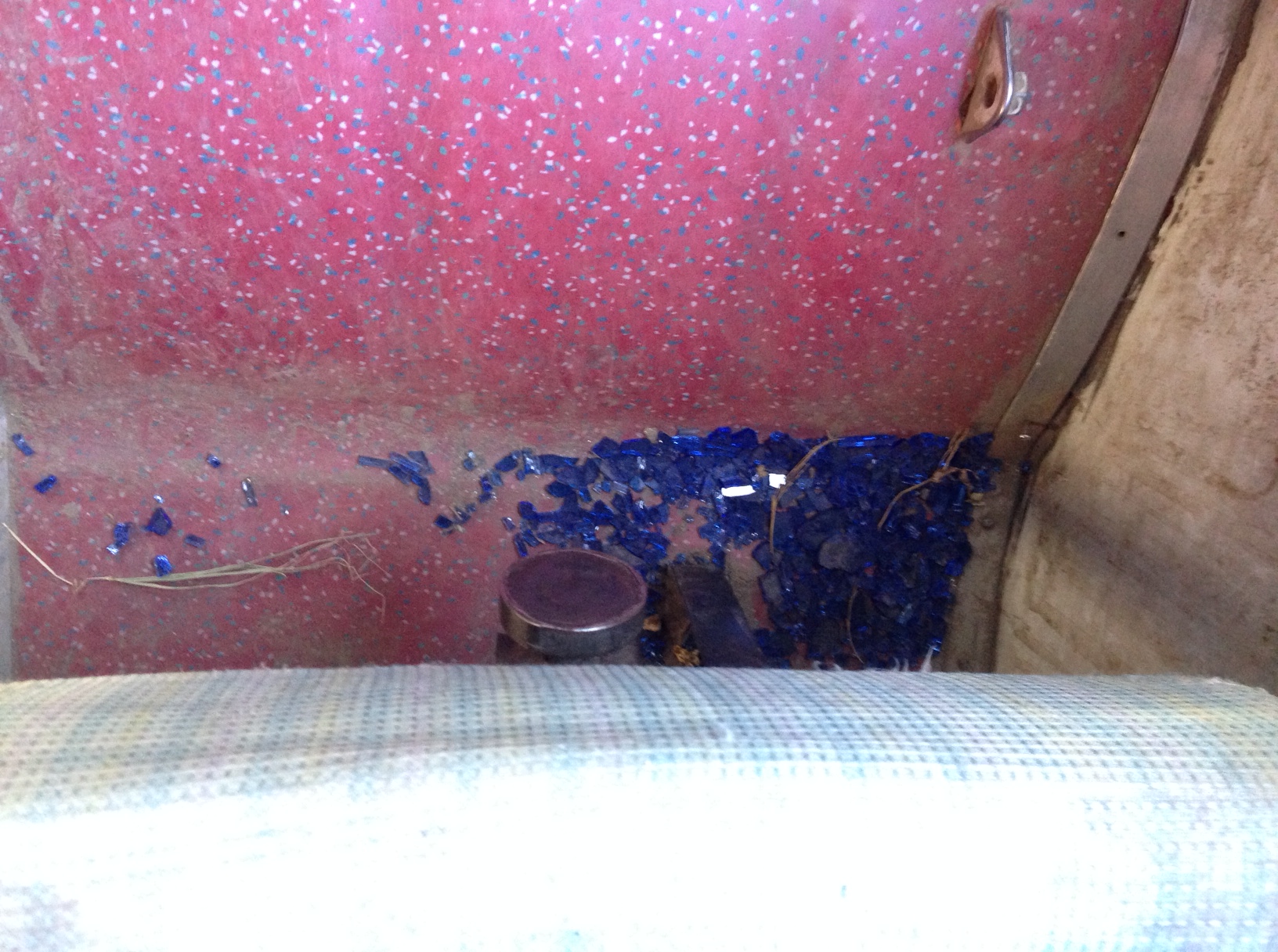
I watched in seemingly slow motion as the driver’s door swung open as we banked around one of the first sharp turns in the road. The door shifted violently in its hinges and slammed into my windows, a set of two sliding glass panes, a thick, translucent blue.
Glass that I shook off my lap onto the floor.
There was a moment of shocked, unblinking silence. Then the window shattered, splaying shards of glass onto my chest, arms and lap. I stared down. A moment later, I started to laugh, shaking my head at the absurdity of the situation. Everyone was trying to figure out what had happened as I stood up and shook the glass off my pants, brushing it onto the floor as thin pieces poked at my knuckles and thighs. The driver’s second man (you’ll find out about him in a second) picked up my chair cushion and shook it out the window, a pile of fresh glass pooled onto the pavement. If Nepal has taught me anything, it’s that you kind of just need to play along with the situation at hand. This was one of those “what can you do?” moments. Anyways, I already had a story from the trek, and I hadn’t even started it yet.
Airy window breeze – thanks, missing window!
After that initial incident, the bus ride to Syabrubesi was unbelievably beautiful. The road rounded mountains and terraced fields, offering dazzling panoramic views of an agrarian Nepal and the oncoming Himalayas.
At around the five-hour mark in the bus ride, the road failed to be a road.
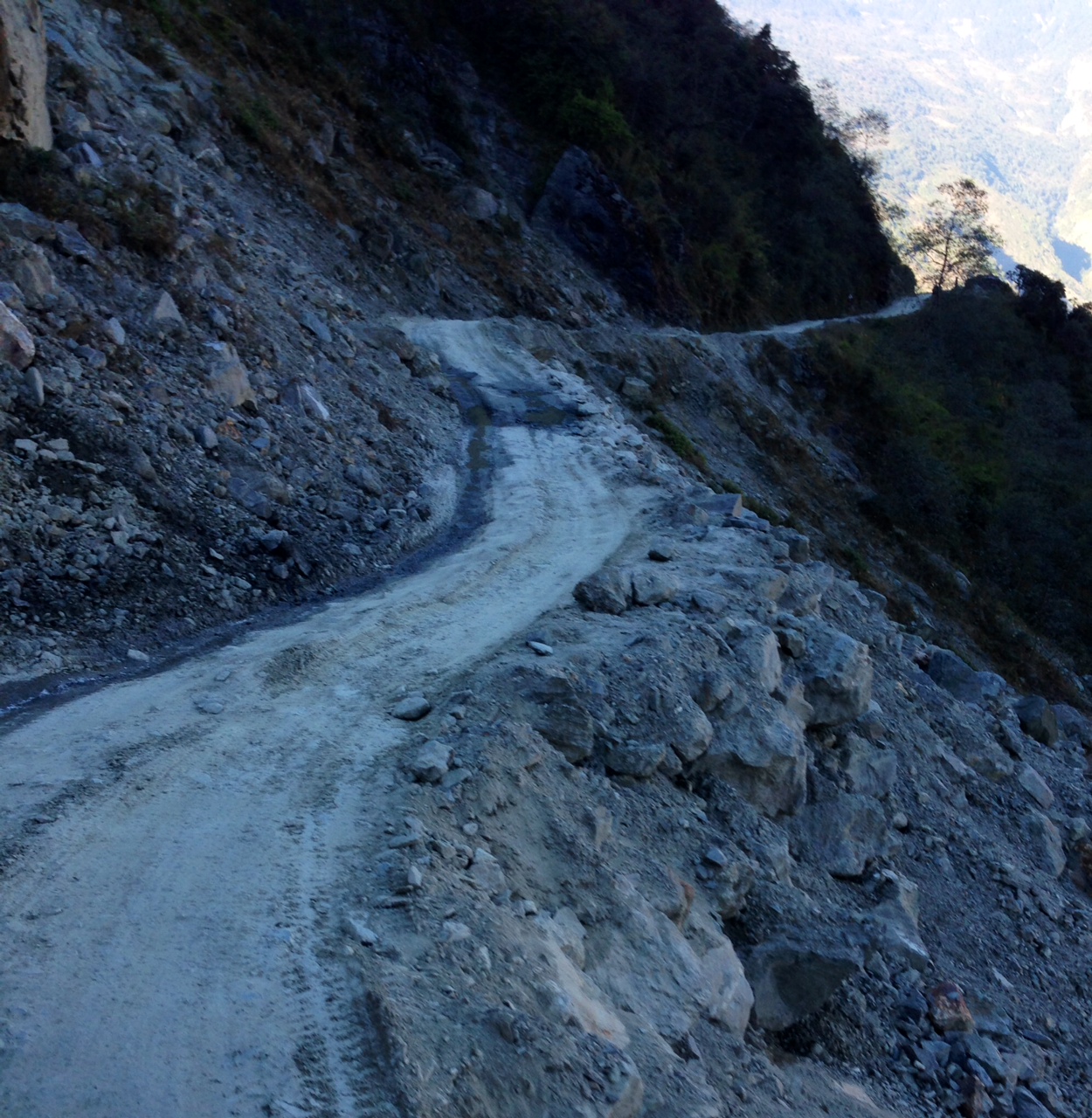
Ravished by landslides, the area to the right of the road was piles of smashed boulders and gravel, the mountain wiped clean in a dirty mess. On the left side of the bus, an epic cliff, one that would have sent the fuselage of our bus barrelling down hundreds of metres.
While photos cannot illustrate the quality of the road, here’s an attempt. An iPhone-sticking-out-the-bus-window shot.
It’s at this point that I see the value in the driver’s second man. His torso sticks out the open bus door. At this point in the journey, it is his job to inform the driver how much space he has before the bus drives off the cliff. He hits the side of the bus rhythmically, a sound that has become synonymous with the idea of “okay, good to go!” I found myself pressing my eyes shut, meditating on the idea of our bus successfully making the pass.
A few lines written in my notebook at around this time: It’s an exercise in trust. You need to work on the assumption that the driver of the bus has the same will to live as you. The road is like a bucking bull, slowly, but determinedly trying to throw us off its back.
Potholes ahead.
Pulling into Syabrubesi, I step onto solid ground, thankful the motion sickness that afflicted my childhood has since passed. An adventure-and-a-half!
Kathmandu to Pokhara
By this point, I should have known that it’s impossible (for me? In general?) to take a bus in Nepal without incident. Still, the 206 kilometre, eight-hour journey to Pokhara started off with hopeful optimism and a breakfast of peanut butter spread on freshly baked buns, a bespeckling of crumbs accompanying Marlon and I on the journey.
Things were uneventful for the first six hours. The switchbacks out of the Kathmandu Valley seemed tame in comparison to the road to Syabrubesi (it’s amazing how base level standards adjust as you travel through a country). I managed a few hours of sleep as the bus rocked back and forth at a leisurely pace along the highway strip next to the Trisuli River. We were just rolling out of our third stop of the bus ride when the driver slammed on the brakes. Everyone fell forward in their chairs. I yanked out my headphones and sat up straight to try and see what was going on. The bus started moving again, slower than before. We pulled over once, went a few metres, and pulled over again.
Our broken down bus
Now I sit near the back of the bus as it lurches forward onto the side of the road, a dusty mechanic shack, an empty gas station.
I look up to the driver’s compartment for answers. The platform where the gear shifter is has been swung open like the hatch on a car. I watch as grey smoke fills the cabin, a fresh puff every time the engine churns to life. So the engine isn’t dead. That is good news. Now, the sound of metal on metal, someone hammering at something under the body of the bus. I sit back and take out my notebook. We could be here awhile.
We are here awhile. It has been more than an hour so far. Over the course of that time period, about four men have been fumbling with the workings of our bus. Testing the axis: left, right, left, right. A cut metal barrel is placed under the bumper as a rush of oil drips in. A man steps out of the driver’s compartment, hands slick with grease.
Another hour passes. Marlon and I see people starting to take their backpacks out of the bus. We’re told the bus is broken and that we will have to wait another hour for a replacement to come. We resign ourselves to getting tea, happy that we at least know what’s going on. But wait! Minutes later we’re told to repack our things and get on the bus. What happened to be a jammed axis on a very winding road was apparently fixed. Turns out this bus shall be our noble steed after all.
The two-hour rest stop led to artsy gas station photos…
And it was, slowly but surely – we got to Pokhara, after 10 hours total. The bus chugged into the city, offering brilliant window views of the Annapurna Himalayan Range and golden lit fields as we went.
So, it really isn’t just about the destination, but the adventure it took to get there, too. Here’s to many more bus rides through Nepal – I still need to ride on the roof of a bus, so who knows what stories that will yield.
PS, an honourable mention bus story: On the ride from Janakpur to Ilam, a ceiling bar came loose, swinging down and almost hitting Marlon and I in the face (coincidentally, we were sitting in those same seats, right behind the driver). A young Nepalese teen looked at me and said frankly “you never know what can happen on a bus in this country!”
This is an entry I’ve been meaning to write since that very first climb on my Everest Base Camp trek. Almost a month has passed since I finished that trek, but it has been just a few days since I bagged my second trek: the Tamang Heritage Trail in Langtang National Park (as always, see future post). The steep ascents and descents presented by that six-day trek – as well as the additional challenge of carrying my own heavy backpack (my organized EBC trek included a porter) – meant this trek was physically demanding in a different kind of way. And so, while trodding through rhododendron forests and over dusty, landslide ridges, I’ve been revisiting the idea of climbing: how it makes me feel, and the lessons it has taught me. So, here we go. A long overdue post.
Sunrise over Kala Patar (5,550 metres)
Trekking has challenged me in ways I never imagined it would. Yes, the exercise-related element was expected, but what was more surprising were the temporary visits from some mental and health-wise ineptitude – the obstacles of my mind. Multi-week treks are all about repetitive action. Sure you’re seeing different, beautiful things everyday, but in the end it comes down to the fact that your days are spent walking and walking and walking. For me, the consistency of that action, as well as the altitude, wore away at buried weaknesses with a steady abrasion, until I had no choice but to deal with them on a surface level. For me, this has always involved thoughts of not being good enough, though only by my own standards. It was also the concern that I have never really been pushed hard enough in my life, and that when the time came to overcome a challenge, particularly a physical one, I would crumble and fail. Dramatic, but bear with me.
On the Everest Base Camp trek there were climbs and then there were climbs. The first, non-italicized category, involved those first, lower altitude ascents: the 800 metre dusty switchback into Namche Bazaar, and the morning, uphill walks out of towns which always seemed to be at the bottom of mountains and valleys.
Then there were the climbs. Spread over three main days, they were a trifecta of unravelling emotions, yet eventual success.
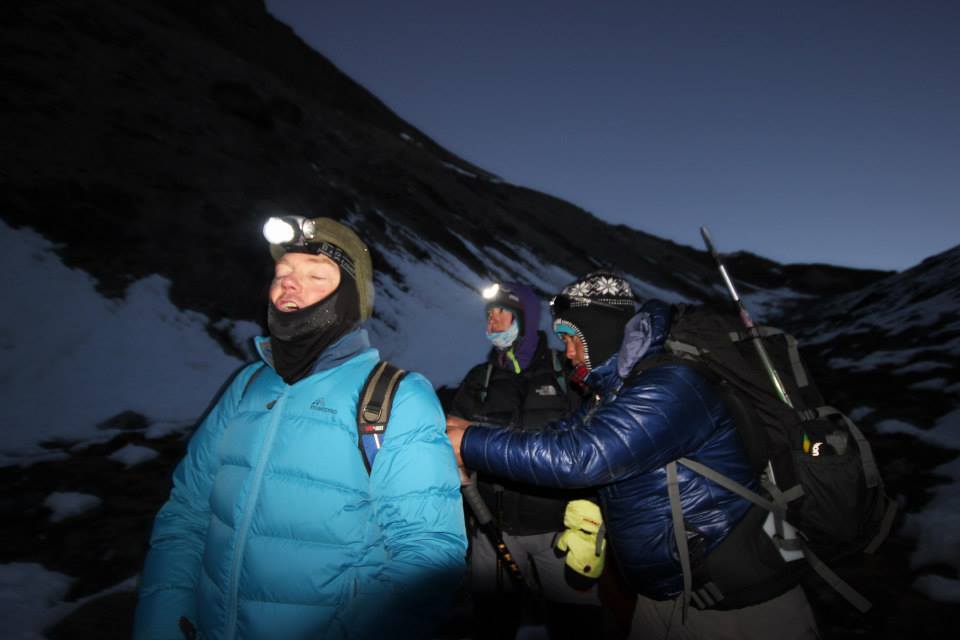
A photo taking by one of my EBC trekking companions, Donny. This is Chris, Gopal (our guide) and I at 4:30 a.m., starting the long walk up to the Cho La Pass.
Gokyo-Ri (5,360 m), climbing onto the Cho La Pass (5,330 m), and Kala Patar (5,550 m).
Each taught me something different about perseverance and my personal limits.
Looking down from Kala Patar. I get cold just seeing this photo!
The most challenging for me was Gokyo-Ri. The peak towers over the Gokyo Valley, home to crystal clear glacier lakes and Tibetan views. It was the climb we faced on day nine, just past the halfway mark of the trek. Gokyo-Ri is steep, so steep I had the sensation of climbing a ladder for most of the time.
When I look back in my notebook to the section written on this day, I am having to edit out a lot of bad words – a frustrated and exhausted entry written from our tea house window, looking up at the mountain just conquered. Spirits were high when I started out – after an altitude sickness and helicopter rescue scare the day before in Machermo, I was happy to have made it to Gokyo, another day closer to base camp. The group of us started out at around 7 a.m. Tight dirt switchbacks welcomed us to the first portion of the trail, grit blowing up beneath my feet, mingling with my saliva and crunching between my teeth. Then it was dead grass. And then, the most technical portion: big rocks, small rocks, all the rocks in the world it seemed, piled there above me. Stones were flung loose beneath hikers, rolling down the steep slope and taking the path of least resistance, which usually meant almost whacking someone in the face. I was stumbling and tired.
The thing about Gokyo-Ri were the false peaks, the half a dozen times when I looked up and saw what I thought was the top of our climb. Not so, Hilary, not so. My assumption of achieved ascent let me down, compounding on what was already a flurry of heavy breathes and aching calves. I didn’t think I could make it.
That’s when I started meditating. I had been muttering expletives up to this point, and decided to focus my muttering on something a little more productive.
And so, my official trekking mantra was born. There are three variations:
You are young, you are strong, you are breathing.
You are young, you are strong, you are healthy.
You are young, you are strong, you are lucky.
I am not joking when I tell you that these three phrases got me through the toughest remaining days of my trek, including the following two climbs. Variation number one was recited when I started to focus too much on my shallowness of breath and the thinness of air – a time when my heart would get panicky and I could feel my pulse quicken by the second. The second was a reference to my bout of AMS at the beginning of the trip, and a reminder to be grateful that my body is fully capable and functioning. Finally, there’s the luck. I used this third mantra for days when I was feeling cranky, tired, and lazy. Because how many people get the chance to trek to Everest Base Camp, to check something off their bucket list? It’s an acknowledgement of appreciation, in the purest form.
Significant summits and points along the trek were always decorated with strings of prayer flags. Here, the view from the top of Gokyo-Ri. Including an incredibly happy me.
Those climbs also taught me of the amazing capacity of the human body – of my body. A little over a year agoI read a great feature in The Walrus magazine about marathon runners. Here’s an excerpt:
“Noakes proposed that the brain is wired to protect itself by pre-emptively shutting down your muscles before any part of your body reaches total failure. If your muscles are being depleted of oxygen and your heart is working too hard; or if you are becoming dangerously dehydrated; or if your core temperature is rising excessively; or if you are climbing a mountain and the amount of oxygen reaching your brain drops significantly – in all of these situations, a “central governor” in your brain acts to slow you down or stop you before you do irreversible damage. You stop not because you can’t physically go any further, but because your brain thinks you shouldn’t.”
On days when I felt mentally worn down and my mind was telling me I couldn’t take one more step, I kept this in mind. Sure enough, my body did not slump over and stop working – it trudged forward. Our brains are miraculous tools, but sometimes they can be our own worst enemy. I trust my body so much more following the Everest trek, and know that it has the ability to be pushed and respond positively.
These mantras and the idea of putting my body to the test were put on trial this past week with the Tamang Heritage Trail. Carrying my own backpack turned out to be a completely different beast, and it weighed down on my knees and feet in a way I didn’t think was possible. The extra kilogram of yak cheese that I bought and had to carry probably didn’t help, either (but cheese is always worth it).
Whereas the Evesest Base Camp trek was made up of long days of walking with varied topography, the Tamang Heritage Trail was almost a constant up or down. Both were painful in their own ways, but the uphill was particularly steep, with an estimated 15-20 degree incline grade at some points. On one day, the trail climbed 700 metres in just over an hour.
A switchback road indicating part of the climb on Day One of the Tamang Heritage Trail. We climbed up a steeper, local path.
At the bottom of steep inclines, I would feel my body start to utter an obligatory groan. But climbing has taught me that complaining won’t get you anywhere closer to the top. One of my new friends and trekking companions, Joseph, said it best as we were staring up at the next hill: “well, it’s not going to climb itself, is it?” I loved that statement, the sentiment of taking a deep breathe and going at things one step at a time.
New trekking friends, Toncie and Nina, climbing, of course.
In the end, the last two treks have taught me things about myself that I didn’t think I needed to learn. I can only hope that I can apply these mantras and increased physical awareness to life back at home. It’s always been a goal of mine to complete a triathlon. Maybe these new lessons can help me get there.
(Getting caught up on blog posts, thus you are hereby teleported to the beginning of December again!)
My last two visiting spots in Nepal have continued to play on that “day and night” theme I mentioned a few posts ago, only this time in a less literal sense.
Janakpur to Ilam – the difference between the two eastern Terai towns is something extraordinary. Whereas Janakpur is a palette of colours, sounds and people, Ilam offers a complete foil.
The best way to describe Ilam is “calm and quiet.” It’s a classification that probably isn’t that surprising, as the town is best known for its tea fields, the green bushes carpeting the rolling contours of the terrain and creating a geometric pattern of square-shaped foliage across the landscape. It’s a change I welcome beyond belief, after the overwhelming assault to my senses and personal space that was Janakpur and the proceeding and precluding bus rides.
Ilam is Nepal’s answer to India’s Darjeeling region (which is just a short hop, skip and a jump away). Outside our guest house is a set of stairs that leads up through tea fields and onto a dirt road, which twists around the mountain, each turn offering another spectacular view.
Marlon and I took a walk up here the other day, and found ourselves flabbergasted, outside the realm of caring that we were each taking the same tea field photo a dozen times. The clouds hung heavy over the nearby mountaintops, allowing just a few spotlights of sun through, highlighting tiny tea houses and patches of field. It is one of the most beautiful sights I’ve seen on this trip so far.
Our four days in Ilam have mostly served as a break from the rush of Kathmandu. Days haven’t started too quickly, meals have been frequent, and much Ilam tea has been consumed. As I have learned over the past month, nothing in Nepal moves quickly (except the traffic). With everything slogging along at a relatively carefree pace, Marlon and I decided to embrace it and do the same.
We did have one big exploration day, an adventure I consider the highlight of our time in Ilam. On December 10, Marlon, Colin (a Canadian expat living in Malaysia who we met while waiting for the Janakpur-bound bus in KTM), and I spent the day trekking through different parts of the Ilam district, aiming to end up in a village named Sanrumba. Colin had read about a local market held there every Tuesday, and we decided it was a worthy end goal for our hike.
Setting foot from our guesthouse, the trek just re-emphasized the dramatically varied landscapes that can be found in Nepal. Last month I was strolling through alpine regions, past glacier lakes and thick silver birch forests. This month, it is through tea fields and paths lined with tall bamboo stalks and edged along paddy fields. Our route to Sanrumba was not so much a real trail, in so much as we had an intended direction for the village, as well as the knowledge that we needed to go down, across some river, and then up again. This meant we were primarily walking down through people’s backyards, their questioning stares turning into broad smiles, as we pressed our palms together and offered a friendly “Namaste!”
Nice day for a walk
After an hour-and-a-half, our path led to a small stream. Despite having just passed a local man whom, upon being asked the direction to Sanrumba, pointed in the opposite direction, we decided the way across this stream must somehow be a shortcut. So we unlaced our hikers, stripped off our socks, and waded in for the easy crossing. I rolled my pants up to my ankles and left my camera dangling around my neck. It turns out one should not judge the depth of a stream from the banks, and we were quickly knee-deep in speedy currents, balancing on slippery rocks. Luckily, the crossing was made without any camera drowning incidents, and we sat on flat boulders across the stream, soaking up the sun and drying our feet/my pants. About 20 minutes later we found a real bridge leading right back across that same stream, and encountered the same local man, who smiled knowingly as we yelled out about the pleasantries of our mistaken loop.
Shortly later we reached the real valley we were supposed to cross. A dam had been constructed to the right, a locals sat on the ground chipping away at big stones to make gravel. We crossed a metal bridge that was still under construction, propped up by a bamboo structure (that was really freaking cool). Obligatory self-timer photos of our trio were taken, as we pretended to be gymnasts, leaping across the metal bars.
Adult playground!
Then, it was time to climb. After an hour’s ascent, wondering when we would reach the elusive Sanrumba, a local on a motorbike told us we were at our destination. We looked off above the dirt road at the stacked potato fields, banana trees, and scattered houses, and spent the next little bit searching for our Tuesday market, which, to date, its existence we have yet to confirm. So, market-less and lunch-less, we sat at the edge of a terraced garden and ate mini oranges, as a handful of local children pointed and stared. It was a picnic with a view, and we looked up at the opposite mountaintop, anticipating the uphill, late afternoon climb back to Ilam.
Rice fields along the way.
That return walk was tiresome, but enjoyable, and we stopped at one of the many snack shops (they kind of remind me of camp tuck shops) to reload our blood sugar levels with more juicy oranges, coconut cookies, and chocolate. We sat there for a while with the locals, spitting out orange seeds, drinking delicious spiced black tea, and mimicking an especially-exuberant rooster.
Back in Ilam, we quickly decided we needed real food, and Colin recommended we find a place that made sukuti, a plate of gingery dried water buffalo meat and vegetables. We ended up in the back room of a small restaurant with the dish at hand, sipping tongba, a Himalayan speciality made by pouring boiling water into a metal pot filled with fermented millet. Our giant metal cups looked as though they were part of the Wizard of Oz’s tin man, and we sipped away at the brews like happy children. Just as we thought our re-fills of tongba were enough, the owner of the restaurant came over with a plastic pitcher, like those you usually use to serve lemonade, its sides embossed with colourful illustrations of flowers and fruit. “Local,” he said, in a way that wasn’t a question. “Local” is the name for raksi, a distilled rice wine home-brewed in kitchens across Nepal, to a varying degree of alcohol percentage and flavour. Over the next two hours we had what was four ounces of quite-potent raksi, chasing down the burning flavour with a mouthful of tongba.
Sukuti, a tankard of tongba, and a heck of a deal: an unmarked litre of raksi. Special thanks to Marlon, who is getting particularly good at modelling inanimate objects for the blog.
Six o’clock (yes, really) hit like a brick wall. The three of us were, pardon my french, hammered, we proceeded to walk down the darkened main street of Ilam (everything closes so early!) in search of chocolate and/or cookies. Along the way, we encountered four early-twenties Nepalese men who were celebrating a friend’s birthday. Our conversation was peppered with the standard country-of-origin curiosities I’ve come to anticipate (Sister! Sister! Where you from, sister?). The mention of Canada quickly changed the subject to talk of singer Bryan Adams, who is huge in Nepal, and whose concert in Kathmandu a few years ago attracted nearly every local I’ve met, it seems. Before I knew it, the handful of us were belting out “Summer of ’69” on the street, our new Nepali friends filling in the lyric gaps when the real Canadians failed to remember the words to the anthem.
We all went to bed embarrassingly early that night, our stomachs full and minds filled with catchy Canadian singalongs.
Today I returned to that restaurant from last night and bought a bottle of homemade raksi for the Nepal-inspired feast I intend to host when I’m back home. The owner funnelled the brew from a giant windshield wiper container into a one litre plastic water bottle, the contents of which he poured onto the street. The total cost? One hundred rupees, or $1 CAN. At that potency and price, raksi could be a dangerous import. I also bought Ilam tea, of course, to add to my already-large collection of masala and milk teas.
















 Hilary Makes