Cross-country bus adventures

Until travelling to Nepal, my token bus story always involved a 17-year-old me and an overextended bathroom break at a gas station in the middle of Norway. Today I find myself with a whole slew of new stories, ones to laugh at in the moment and remember fondly once the intended destination is reached.

Please allow me to share my most recent two:

The road to Syabrubesi

It turns out my overnight bus ride from Kathmandu to Janakpur was not the most eventful, dually fearsome and exciting trip I would be having during my time in Nepal.

Syabrubesi is the start point of the Tamang Heritage Trail, that trek I did just before Christmas. When I read in Lonely Planet that the bus ride from Kathmandu to the northern town was the worst part of the Langtang region treks, I knew I was in for a treat. At just over 120 kilometres in distance, the bus ride takes a whopping seven hours (that’s just a shade over 17 km/hr, on the super deluxe speedy bus, might I add) from start to finish. But I was ready. Armed with a breakfast of rice crackers and a jar of peanut butter (guilty creature comfort), I settled into my spot in the seat behind the driver. We started off through the early morning smog, up and out of Kathmandu into the mountains. I turned my attention to admire the fading views of the valley, and twisted the lid back onto my peanut butter jar.

WHAM! SMASH!

I watched in seemingly slow motion as the driver’s door swung open as we banked around one of the first sharp turns in the road. The door shifted violently in its hinges and slammed into my windows, a set of two sliding glass panes, a thick, translucent blue.
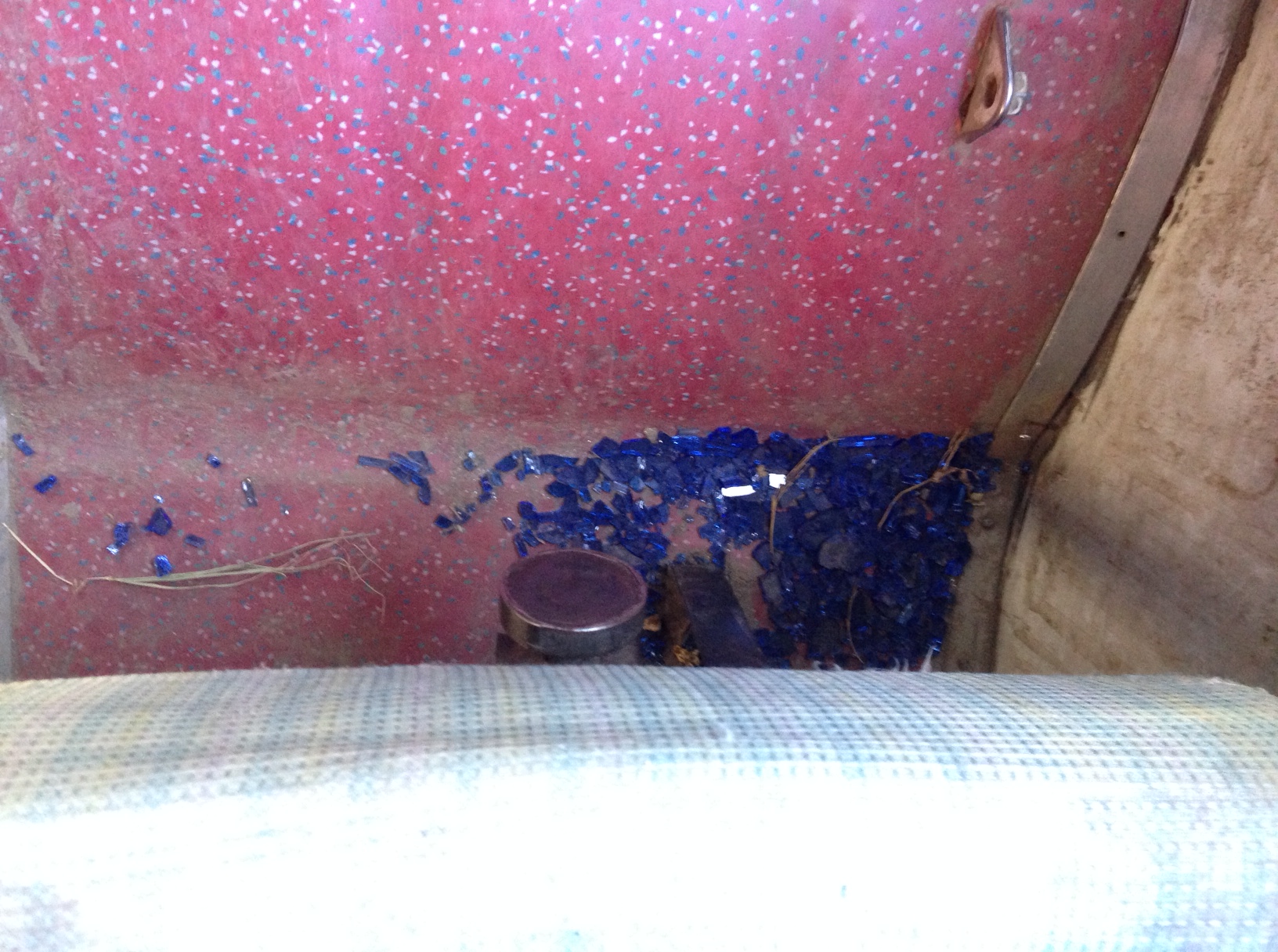
Glass that I shook off my lap onto the floor.

There was a moment of shocked, unblinking silence. Then the window shattered, splaying shards of glass onto my chest, arms and lap. I stared down. A moment later, I started to laugh, shaking my head at the absurdity of the situation. Everyone was trying to figure out what had happened as I stood up and shook the glass off my pants, brushing it onto the floor as thin pieces poked at my knuckles and thighs. The driver’s second man (you’ll find out about him in a second) picked up my chair cushion and shook it out the window, a pile of fresh glass pooled onto the pavement. If Nepal has taught me anything, it’s that you kind of just need to play along with the situation at hand. This was one of those “what can you do?” moments. Anyways, I already had a story from the trek, and I hadn’t even started it yet.

image_3
Airy window breeze – thanks, missing window!

After that initial incident, the bus ride to Syabrubesi was unbelievably beautiful. The road rounded mountains and terraced fields, offering dazzling panoramic views of an agrarian Nepal and the oncoming Himalayas.

At around the five-hour mark in the bus ride, the road failed to be a road.

Ravished by landslides, the area to the right of the road was piles of smashed boulders and gravel, the mountain wiped clean in a dirty mess. On the left side of the bus, an epic cliff, one that would have sent the fuselage of our bus barrelling down hundreds of metres.

While photos cannot illustrate the quality of the road, here's an attempt. An iPhone-sticking-out-the-bus-window shot.
While photos cannot illustrate the quality of the road, here’s an attempt. An iPhone-sticking-out-the-bus-window shot.

It’s at this point that I see the value in the driver’s second man. His torso sticks out the open bus door. At this point in the journey, it is his job to inform the driver how much space he has before the bus drives off the cliff. He hits the side of the bus rhythmically, a sound that has become synonymous with the idea of “okay, good to go!” I found myself pressing my eyes shut, meditating on the idea of our bus successfully making the pass.

A few lines written in my notebook at around this time: It’s an exercise in trust. You need to work on the assumption that the driver of the bus has the same will to live as you. The road is like a bucking bull, slowly, but determinedly trying to throw us off its back.
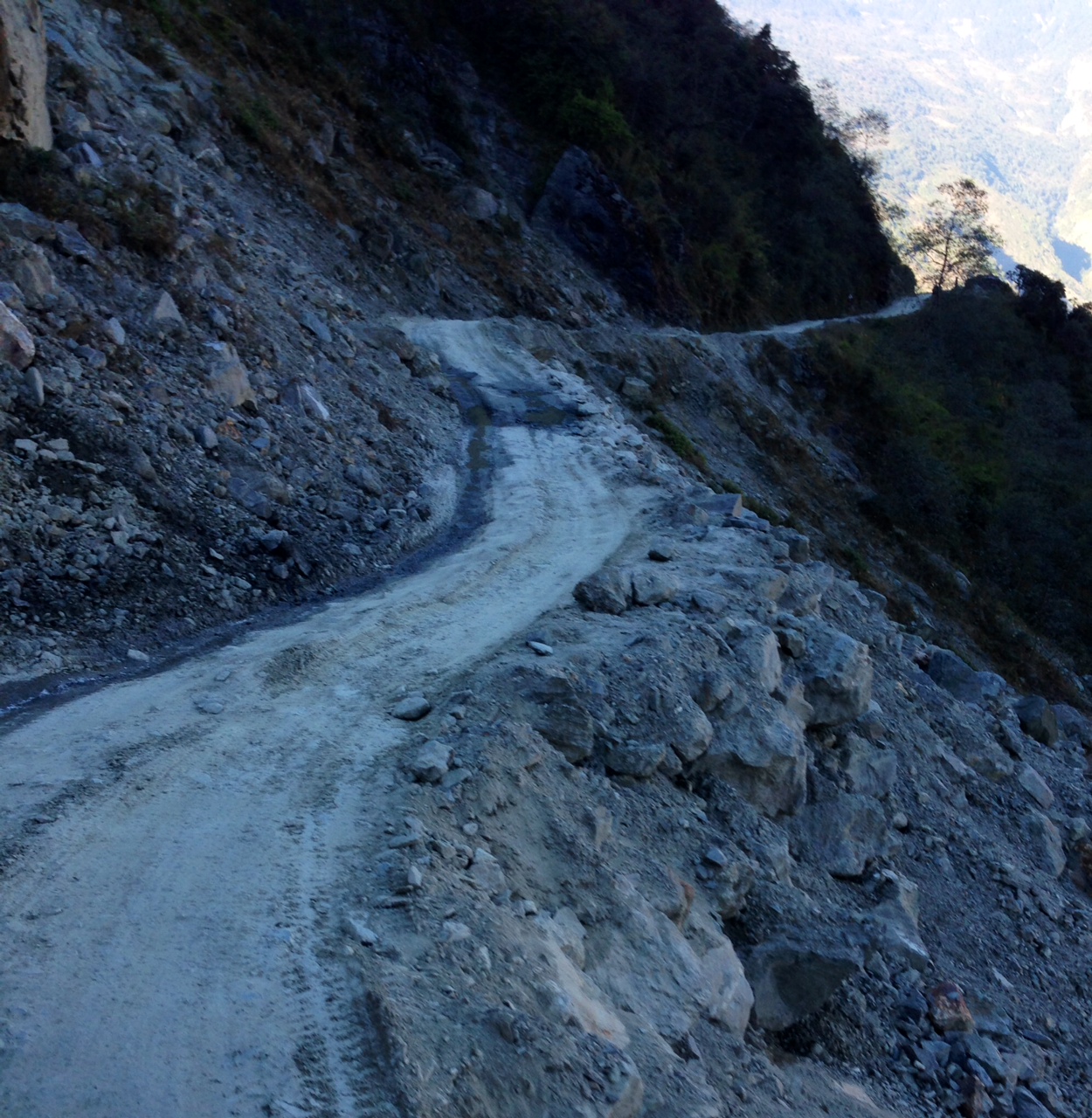
Potholes ahead.
Potholes ahead.

Pulling into Syabrubesi, I step onto solid ground, thankful the motion sickness that afflicted my childhood has since passed. An adventure-and-a-half!

Kathmandu to Pokhara

By this point, I should have known that it’s impossible (for me? In general?) to take a bus in Nepal without incident. Still, the 206 kilometre, eight-hour journey to Pokhara started off with hopeful optimism and a breakfast of peanut butter spread on freshly baked buns, a bespeckling of crumbs accompanying Marlon and I on the journey.

Things were uneventful for the first six hours. The switchbacks out of the Kathmandu Valley seemed tame in comparison to the road to Syabrubesi (it’s amazing how base level standards adjust as you travel through a country). I managed a few hours of sleep as the bus rocked back and forth at a leisurely pace along the highway strip next to the Trisuli River. We were just rolling out of our third stop of the bus ride when the driver slammed on the brakes. Everyone fell forward in their chairs. I yanked out my headphones and sat up straight to try and see what was going on. The bus started moving again, slower than before. We pulled over once, went a few metres, and pulled over again.

Our broken down bus
Our broken down bus

Now I sit near the back of the bus as it lurches forward onto the side of the road, a dusty mechanic shack, an empty gas station.

I look up to the driver’s compartment for answers. The platform where the gear shifter is has been swung open like the hatch on a car. I watch as grey smoke fills the cabin, a fresh puff every time the engine churns to life. So the engine isn’t dead. That is good news. Now, the sound of metal on metal, someone hammering at something under the body of the bus. I sit back and take out my notebook. We could be here awhile.

We are here awhile. It has been more than an hour so far. Over the course of that time period, about four men have been fumbling with the workings of our bus. Testing the axis: left, right, left, right. A cut metal barrel is placed under the bumper as a rush of oil drips in. A man steps out of the driver’s compartment, hands slick with grease.

Another hour passes. Marlon and I see people starting to take their backpacks out of the bus. We’re told the bus is broken and that we will have to wait another hour for a replacement to come. We resign ourselves to getting tea, happy that we at least know what’s going on. But wait! Minutes later we’re told to repack our things and get on the bus. What happened to be a jammed axis on a very winding road was apparently fixed. Turns out this bus shall be our noble steed after all.

The two-hour rest stop led to artsy gas station photos...
The two-hour rest stop led to artsy gas station photos…

And it was, slowly but surely – we got to Pokhara, after 10 hours total. The bus chugged into the city, offering brilliant window views of the Annapurna Himalayan Range and golden lit fields as we went.

So, it really isn’t just about the destination, but the adventure it took to get there, too. Here’s to many more bus rides through Nepal – I still need to ride on the roof of a bus, so who knows what stories that will yield.

PS, an honourable mention bus story: On the ride from Janakpur to Ilam, a ceiling bar came loose, swinging down and almost hitting Marlon and I in the face (coincidentally, we were sitting in those same seats, right behind the driver). A young Nepalese teen looked at me and said frankly “you never know what can happen on a bus in this country!”

You never know, but that’s half the fun.

Finding peace (and raksi) in Ilam

(Getting caught up on blog posts, thus you are hereby teleported to the beginning of December again!)

My last two visiting spots in Nepal have continued to play on that “day and night” theme I mentioned a few posts ago, only this time in a less literal sense.

Janakpur to Ilam – the difference between the two eastern Terai towns is something extraordinary. Whereas Janakpur is a palette of colours, sounds and people, Ilam offers a complete foil.

?????????????????????????????????????????????????????????????????????????

The best way to describe Ilam is “calm and quiet.” It’s a classification that probably isn’t that surprising, as the town is best known for its tea fields, the green bushes carpeting the rolling contours of the terrain and creating a geometric pattern of square-shaped foliage across the landscape. It’s a change I welcome beyond belief, after the overwhelming assault to my senses and personal space that was Janakpur and the proceeding and precluding bus rides.

03-IMG_2467

Ilam is Nepal’s answer to India’s Darjeeling region (which is just a short hop, skip and a jump away). Outside our guest house is a set of stairs that leads up through tea fields and onto a dirt road, which twists around the mountain, each turn offering another spectacular view.

09-IMG_2519

Marlon and I took a walk up here the other day, and found ourselves flabbergasted, outside the realm of caring that we were each taking the same tea field photo a dozen times. The clouds hung heavy over the nearby mountaintops, allowing just a few spotlights of sun through, highlighting tiny tea houses and patches of field. It is one of the most beautiful sights I’ve seen on this trip so far.

08-IMG_2502

05-IMG_2484

Our four days in Ilam have mostly served as a break from the rush of Kathmandu. Days haven’t started too quickly, meals have been frequent, and much Ilam tea has been consumed. As I have learned over the past month, nothing in Nepal moves quickly (except the traffic). With everything slogging along at a relatively carefree pace, Marlon and I decided to embrace it and do the same.

We did have one big exploration day, an adventure I consider the highlight of our time in Ilam. On December 10, Marlon, Colin (a Canadian expat living in Malaysia who we met while waiting for the Janakpur-bound bus in KTM), and I spent the day trekking through different parts of the Ilam district, aiming to end up in a village named Sanrumba. Colin had read about a local market held there every Tuesday, and we decided it was a worthy end goal for our hike.

Setting foot from our guesthouse, the trek just re-emphasized the dramatically varied landscapes that can be found in Nepal. Last month I was strolling through alpine regions, past glacier lakes and thick silver birch forests. This month, it is through tea fields and paths lined with tall bamboo stalks and edged along paddy fields. Our route to Sanrumba was not so much a real trail, in so much as we had an intended direction for the village, as well as the knowledge that we needed to go down, across some river, and then up again. This meant we were primarily walking down through people’s backyards, their questioning stares turning into broad smiles, as we pressed our palms together and offered a friendly “Namaste!”

Nice day for a walk
Nice day for a walk

After an hour-and-a-half, our path led to a small stream. Despite having just passed a local man whom, upon being asked the direction to Sanrumba, pointed in the opposite direction, we decided the way across this stream must somehow be a shortcut. So we unlaced our hikers, stripped off our socks, and waded in for the easy crossing. I rolled my pants up to my ankles and left my camera dangling around my neck. It turns out one should not judge the depth of a stream from the banks, and we were quickly knee-deep in speedy currents, balancing on slippery rocks. Luckily, the crossing was made without any camera drowning incidents, and we sat on flat boulders across the stream, soaking up the sun and drying our feet/my pants. About 20 minutes later we found a real bridge leading right back across that same stream, and encountered the same local man, who smiled knowingly as we yelled out about the pleasantries of our mistaken loop.

Shortly later we reached the real valley we were supposed to cross. A dam had been constructed to the right, a locals sat on the ground chipping away at big stones to make gravel. We crossed a metal bridge that was still under construction, propped up by a bamboo structure (that was really freaking cool). Obligatory self-timer photos of our trio were taken, as we pretended to be gymnasts, leaping across the metal bars.

Adult playground!
Adult playground!

Then, it was time to climb. After an hour’s ascent, wondering when we would reach the elusive Sanrumba, a local on a motorbike told us we were at our destination. We looked off above the dirt road at the stacked potato fields, banana trees, and scattered houses, and spent the next little bit searching for our Tuesday market, which, to date, its existence we have yet to confirm. So, market-less and lunch-less, we sat at the edge of a terraced garden and ate mini oranges, as a handful of local children pointed and stared. It was a picnic with a view, and we looked up at the opposite mountaintop, anticipating the uphill, late afternoon climb back to Ilam.

Rice fields along the way.

18-IMG_2553

That return walk was tiresome, but enjoyable, and we stopped at one of the many snack shops (they kind of remind me of camp tuck shops) to reload our blood sugar levels with more juicy oranges, coconut cookies, and chocolate. We sat there for a while with the locals, spitting out orange seeds, drinking delicious spiced black tea, and mimicking an especially-exuberant rooster.

Back in Ilam, we quickly decided we needed real food, and Colin recommended we find a place that made sukuti, a plate of gingery dried water buffalo meat and vegetables. We ended up in the back room of a small restaurant with the dish at hand, sipping tongba, a Himalayan speciality made by pouring boiling water into a metal pot filled with fermented millet. Our giant metal cups looked as though they were part of the Wizard of Oz’s tin man, and we sipped away at the brews like happy children. Just as we thought our re-fills of tongba were enough, the owner of the restaurant came over with a plastic pitcher, like those you usually use to serve lemonade, its sides embossed with colourful illustrations of flowers and fruit. “Local,” he said, in a way that wasn’t a question. “Local” is the name for raksi, a distilled rice wine home-brewed in kitchens across Nepal, to a varying degree of alcohol percentage and flavour. Over the next two hours we had what was four ounces of quite-potent raksi, chasing down the burning flavour with a mouthful of tongba.

Sukuti, a tankard of tongba, and a heck of a deal: an unmarked litre of raksi. Special thanks to Marlon, who is getting particularly good at modelling inanimate objects for the blog.

Six o’clock (yes, really) hit like a brick wall. The three of us were, pardon my french, hammered, we proceeded to walk down the darkened main street of Ilam (everything closes so early!) in search of chocolate and/or cookies. Along the way, we encountered four early-twenties Nepalese men who were celebrating a friend’s birthday. Our conversation was peppered with the standard country-of-origin curiosities I’ve come to anticipate (Sister! Sister! Where you from, sister?). The mention of Canada quickly changed the subject to talk of singer Bryan Adams, who is huge in Nepal, and whose concert in Kathmandu a few years ago attracted nearly every local I’ve met, it seems. Before I knew it, the handful of us were belting out “Summer of ’69” on the street, our new Nepali friends filling in the lyric gaps when the real Canadians failed to remember the words to the anthem.

We all went to bed embarrassingly early that night, our stomachs full and minds filled with catchy Canadian singalongs.

Today I returned to that restaurant from last night and bought a bottle of homemade raksi for the Nepal-inspired feast I intend to host when I’m back home. The owner funnelled the brew from a giant windshield wiper container into a one litre plastic water bottle, the contents of which he poured onto the street. The total cost? One hundred rupees, or $1 CAN. At that potency and price, raksi could be a dangerous import. I also bought Ilam tea, of course, to add to my already-large collection of masala and milk teas.

Artistic appreciation: Mithila art

I love collecting art when I travel.

Before I moved out of Jen and Ian’s house in Sudbury, my closet was chalked full of posters, prints, and art cards I’ve amassed throughout my journeys. Yes, you read that right. My closet. The walls and shelves of my bedroom wall have already been covered with a variety of maps and other items, relegating any new additions to my collection to my (very official) archive space, in anticipation that I will one day have more than just a bedroom in which to hang art.

I have gotten two new acquisitions in Nepal: a set of beautiful paintings done by the woman who work at the Janakpur Womens Awareness Society in eastern Nepal. When Marlon and I made the decision to travel to Janakpur, it was mainly for the affore-posted-about festival, but also to learn more about Mithila artwork (Mithila is the name of a region in India, that borders on the Janakpur area).

So, after napping off the effects of our 12-hour overnight bus ride from KTM to Janakpur, Marlon and I snagged a rickshaw and headed to the society office in the next village over.

The style of Mithila art has been traditionally passed down from generation-to-generation amongst Nepali and Indian women. It started off as a way for the artists to document their social history, by “recording the lives of rural women in a society where reading and writing are reserved for high-caste men.” (Lonely Planet, thanks!). The colourful murals were originally painted on the walls of houses and around town (something we witnessed in Janakpur), and has expanded nowadays to include papier mâché boxes and other knick-knacks, as well as paper-based paintings, with which we quickly fell in love.

1-IMG_2223

4-IMG_2228

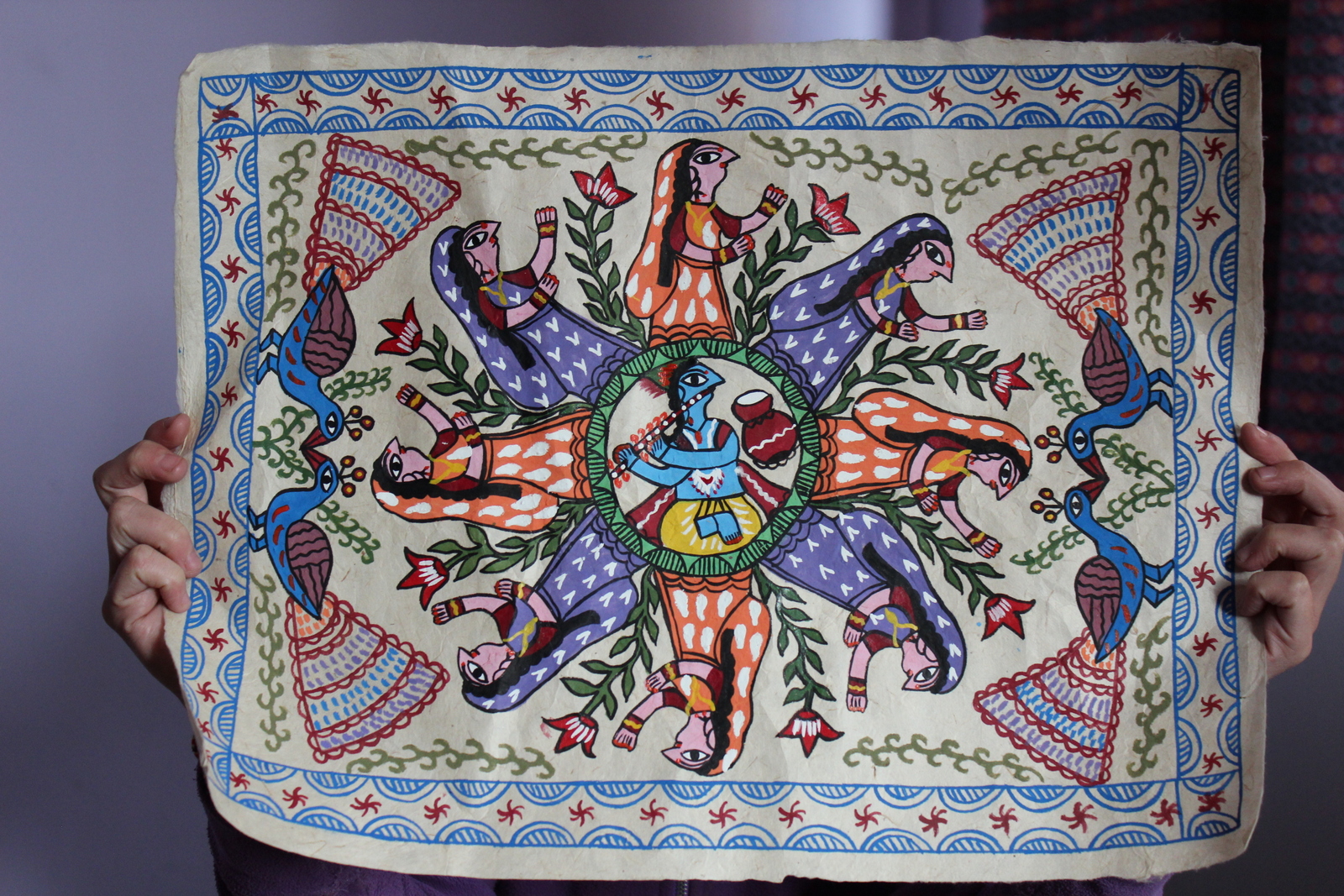
The first painting depicts that idea of documenting everyday activity: traditional housework and cooking.  I think it acknowledges the integral role women play in the functioning of their families. When it comes to women and equality in Nepal, there’s still a long way to go – women are still very much expected to prepare each and every meal for their husband and male family members, and spend hours in the kitchen while their male counterparts drink warmed raksi (local liquor). This painting is documentation of the expected behaviour currently of many women in traditional villages, and I hope that in the near future these Mithila paintings can be depicting different scenes. Until then, every dollar earned from these artworks goes back to the development of women’s programs in Janakpur, which is an excellent first step.

3-IMG_2566

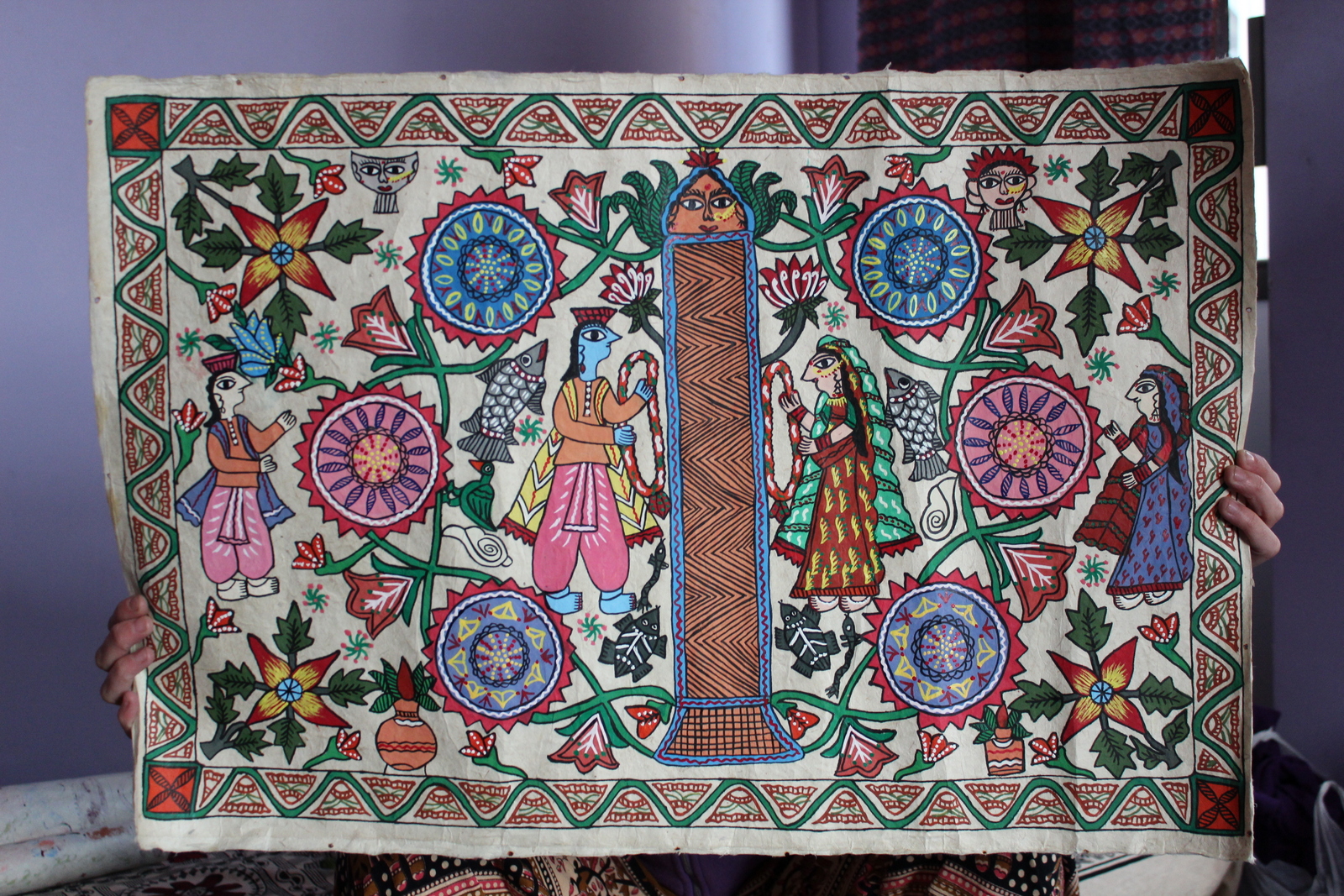
Below is my second Mithila painting, a bit smaller than the first. This one appealed to me for a number of reasons, not the least of which being that it made reference to the marriage of Sita and Rama, why Marlon and I were in Janakpur in the first place.

1-IMG_2567

Marlon got another painting showing the marriage ceremony of Sita and Rama:

2-IMG_2564


The work at the Womens Development Society was absolutely beautiful, and these women are talented beyond belief. I am grateful I had the opportunity to travel to the place where it’s made, and learn more about the story behind the colourful paint and intricate lines.


How many people can you fit into that _______? (Days of madness and discovery in and around Janakpur)

The beginning of this month was a bit of a whirlwind.

On the morning of December 5, I was sitting at my guesthouse in Bhaktapur wondering what to do next. My iPhone was sitting on one knee, my Lonely Planet guide on the other. I had just finished researching a festival called Sita Bibaha Panchami, an annual affair that takes place in the eastern city of Janakpur every year. It celebrates the marriage of Sita, the daughter of the former king of Janakpur, to Rama, one of the incarnations of the Hindu god, Vishnu. That means it’s a hell of a party. According to LP (as I’ve affectionately started calling it), tens of thousands of pilgrims come from India every year, descending upon Janakpur for a week’s worth of festivities.

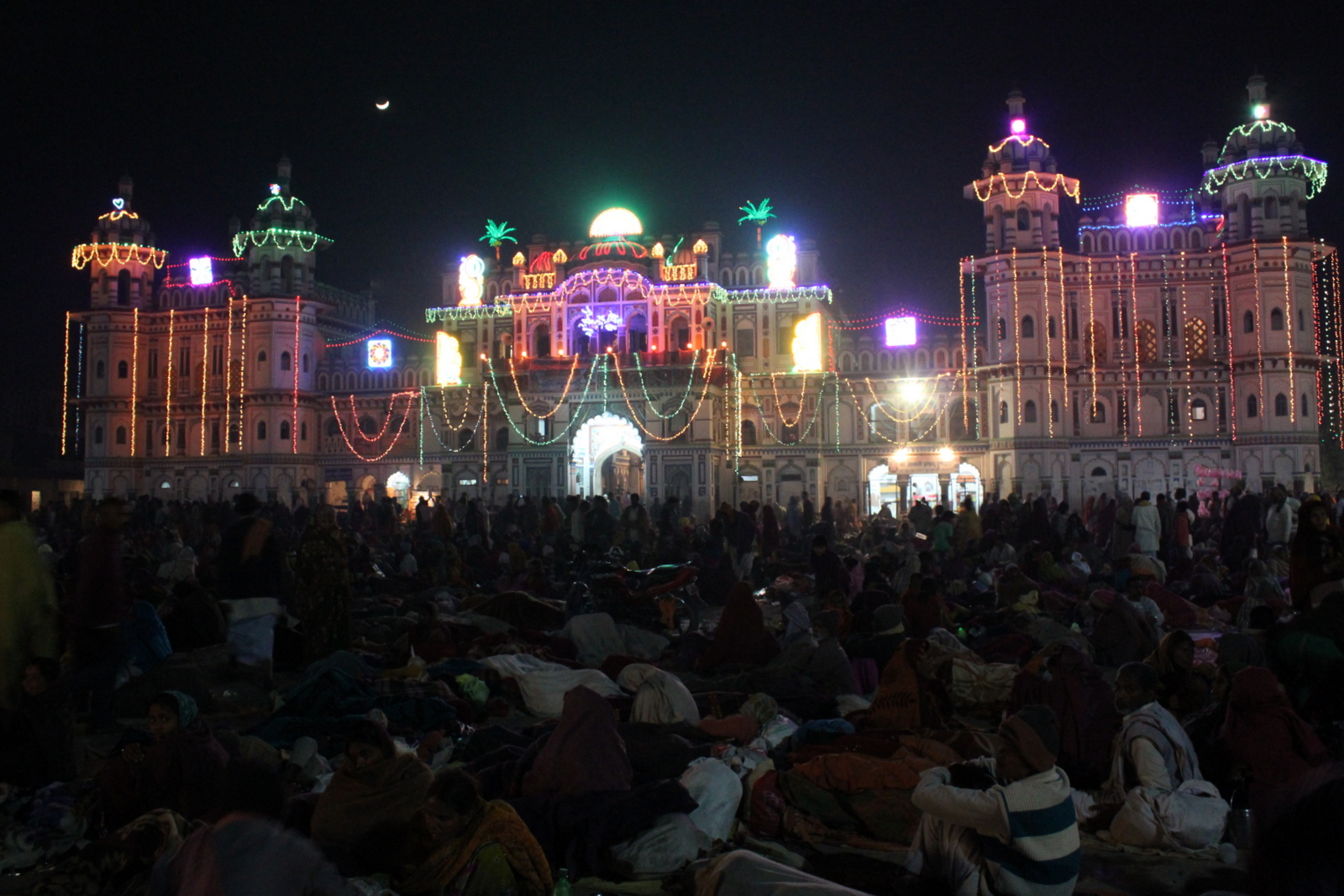
Thousands of pilgrims sleep outside Janaki Mandir temple in Janakpur during the annual Sita Panchami Babi festival.
Thousands of pilgrims sleep outside Janaki Mandir temple in Janakpur during the annual Sita Bibaha Panchami festival.

I wanted to visit Janakpur, and this sounded like the time of year to do so. There’s nothing quite like a city during a festival. So, at around 10:30 a.m. on that December morning, I decided to pack up my backpack, and make my way to the border city. There was just one slight obstacle: timing. The main night of the festival – the re-enactment of Sita and Rama’s marriage – was happening just two days later, on December 7. And Janakpur is halfway across Nepal – a 12-hour bus ride from Kathmandu (which, being in Bhaktapur, I was still an hour away from), across the Mahabharat mountain range and into the heart of the country’s Terai district.

But I had made up my mind. I was Janakpur-bound, and I was going to make it there as soon as humanly possible. I didn’t want to miss a moment more of the party.

02-IMG_2267

I hopped on the next local bus to Kathmandu and found myself back at my original home-base hostel, The Sparkling Turtle, where I had left a few things. There I also encountered my friend Marlon, a Dutch girl I had met during a previous stay. Marlon and I had been casually talking over Facebook about going to Janakpur together, and within minutes, we decided we would be travel companions. It was 1:30 p.m.

Marlon and I, mid-adventure.

The next bus from Kathmandu to Janakpur left at 6 p.m. that evening. Now, if there is one word of advice I’ve read about Nepal, it is that you should avoid overnight buses. The roads are paved and winding at best, and huge pockmarked messes of sand and loose rock at worst. Plus the hairpin turns are sometimes not navigated best in the thickness of night, nor while blindly passing other traffic.

But in the impulse and rush of the moment, we decided to take the bus anyways.

How many people can you fit into that bus?

Bus stations in Nepal (this one in Janakpur) - chaos, only slightly organized. These were like the bus Marlon and I took from KTM to Janakpur.
Bus stations in Nepal (this one in Janakpur) – chaos, only slightly organized. These were like the bus Marlon and I took from KTM to Janakpur.

And so began the next memorable 12 hours of my life. Marlon and I got to the Kathmandu bus station at 4:45 p.m., and were promptly intercepted by half-a-dozen scalpers trying to sell us overpriced bus tickets. Marching up to the ticket counter, giant backpacks in tow, we bought the last two tickets on that night’s single bus to Janakpur. There was just one thing: those last two tickets were to sit up in the driver’s compartment of the bus. Whatever, we thought, as we exchanged ‘should we do it?’ glances. We were just happy to make it on board.

Marlon, all smiles at 6 p.m. The man you see on the left is the bus driver.
Marlon, all smiles at 6 p.m. The man you see on the left (yes, the one on his phone..) is the bus driver.

(At this point, knowing that I’m alive, here is an excerpt from Lonely Planet: “Road safety can be an issue, particularly for night travel. To maximize safety, travel in daylight hours and avoid the front seats.”

Well.

Our local bus ended up being what the Nepalese call a “deluxe” bus, which basically just meant it has fabric covering the seats and is a little less run down-looking than the colourful “Bob Marley” buses that prowl the roads. Boarding the bus, we were initially thrilled with our seats. There were a couple of Nepali men sitting there, and a big pillow of a seat where the bus’ gear shifter was. That’s where I sat, sprawled out lazily, wide eyes watching the road from the wind shield. Then, the sliding door to the driver’s compartment opened. And then it opened again. More and more men piled into that front portion of bus, and Marlon and I were soon relegated onto a small wooden bench directly behind the metal driver’s seat. In total there were nine of us, including the driver, squished into that tiny space. My knee was sat on for nearly the entire night by our bus DJ, the Nepali teenager who blasted a range of Bollywood and Top 40’s tunes (including an extended Akon playlist) without pause throughout the ride. Halfway through the night, Marlon and I gave up on sleeping (every time I dozed off I would bump my head on either the driver’s seat or on the chest of my teenage knee sitter), and joined in the singing, as the DJ and driver sang Aqua’s iconic “Barbie Girl” song as a duet.

We pulled into the dusty bus station in Janakpur at 7 a.m. the next morning, stiff, sore and swearing never to sit at the front of a Nepali bus ever again (for what we did for the rest of the day, see a later post, about Mithila art).

How many people can you fit into that temple?

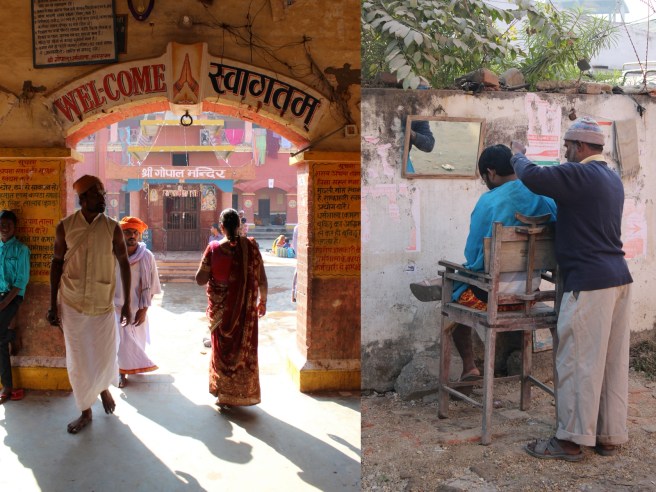
The entrance way of Janaki Mandir, decorated for the festival.

On our second day in Janakpur, Marlon and I got a full dose of festival. Our plan for the day was to basically wander the centre of the city absorbing the atmosphere, take photos, and see what this Sita and Rama marriage celebration was all about. The city was just teeming with people; men and women selling offerings for puja, vendors dousing samosas and honey batter in bubbling oil, pilgrims informally sprawled out and camping on blankets, and holy men, who pursued Marlon and I around Janaki Mandir (the main temple), wanting to “bless us” by tying pieces of red string around our wrists in exchange for money.

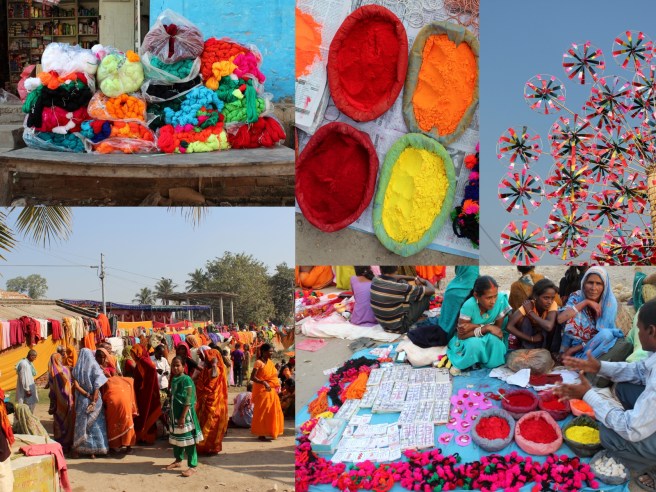
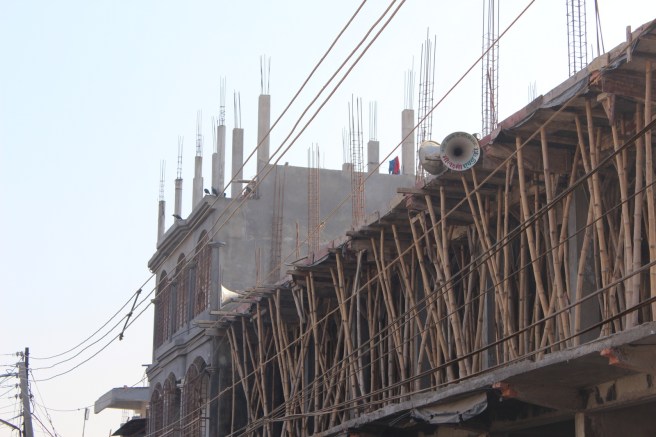
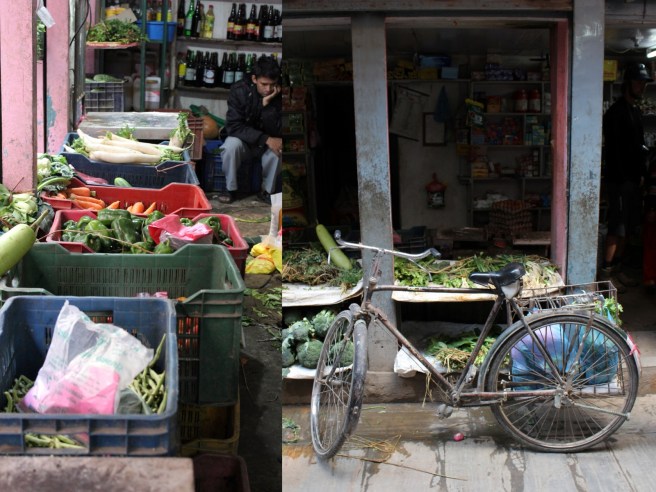
Some of the sights and colours found around Janakpur.
Janakpur storefronts

The mind-numbing sound of the festival did not stop for the entirety of our time in Janakpur. The music played all night through megaphones around the city, the sound occasionally broken up by the crackling of a pilgrim yelling into a microphone.

Our alarm, our sleep depriver.
I loved this - informal Bollywood movie-watching sessions in front of local shops.
I loved this – informal Bollywood movie-watching sessions in front of local shops.

The women looked stunning in their best saris, and their other clothing was draped over fences, rooftops, and balconies. It was a rainbow of an experience, one that smelled like street food and feet and human excrement. I have never watched so many people squat in public as I did in those two days.

Danush Sagar, the largest ceremonial tank in Janakpur, where the pilgrims went to bathe.
Festival street food.
One of my favourite photos from the day. Pilgrims hang clothing to dry from a balcony in Janakpur.

?????????????????????????????????????????????????????????????????????????

Entering Janaki Mandir to visit Sita’s temple was insanity, plain and simple. As Marlon and I stood at the outskirts of the temple, my eyes grew wide. The religious fervour was electric. Pilgrims were pushing and charging into the temple, throwing marigold petals and beaten rice as offerings to the giant idol at the front.

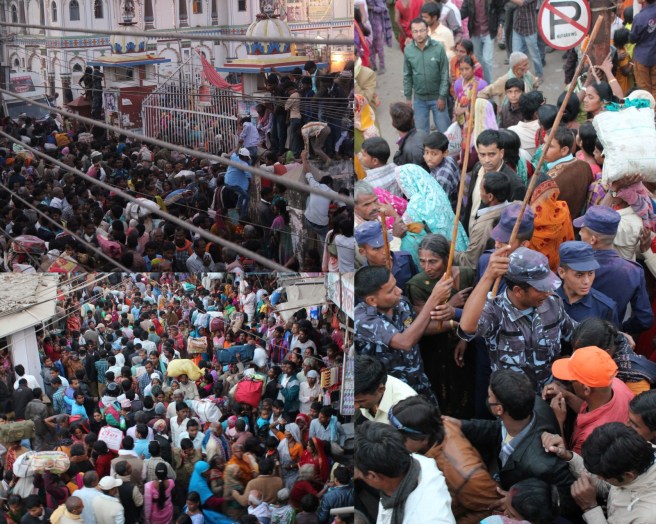
Pilgrims (and us) making their way to the Sita temple.
Pilgrims (and us) making their way to the Sita temple (can you spot Marlon in the second photo?)

A young Nepali boyscout took pity on the two of us, and led us into the mass, where the backs of our bodies were pelted with the aforementioned offerings, making me smile and laugh, until an entire offering of water was thrown onto my head and camera. After we left the swarm, Marlon and I were accosted by pilgrims, some of whom asked, some of whom didn’t, that we pose for photos with them. Westerners are not a common sight in Janakpur.

Later that evening we experienced our second swarm of the day, as we followed the wedding procession parade back to Janaki Mandir.

Parade scenes, as seen from the balcony of a rooftop restaurant along the main road.

The streets around the temple were gridlocked with people, everyone thrusting impatiently forward, wanting a coveted spot within the fence of the temple. At this point, the crowd was about 10 per cent part fun and exciting, and 90 per cent scary.

?????????????????????????????????????????????????????????????????????????

04-IMG_2352

I legitimately thought I was going to be trampled by the hordes of people. I was being grabbed and pushed in every direction, both literally and sense-wise. I looked up, and saw a group of men and woman standing on the rooftop of one of the shops, staring down at the crowds. I made eye contact with one of the men, pointed at myself and Marlon, and then up at where they stood. Luckily, the gesturing and panic in my eyes was enough, and he motioned for us to join them on the roof. From there, I could finally breathe, as well as attempt to capture in photo the madness below.

Crowd and comfort: on the ground versus on the roof.
A bead seller peddles his wares amidst the crowd of pilgrims.
A bead seller peddles his wares on the street by Janaki Mandir.
Janaki Mandir is spectacularly beautiful.

Marlon and I left Janakpur on another local bus the next morning – the same time when the thousands of pilgrims were making the journey back to India, via bus and on Nepal’s only train. We were grateful to have two real seats this time, but our laps were piled high with bags that were not our own, and personal space was a term that existed only in theory. We spent seven hours on that bus to a place called Birtamod, bound for a sleepy tea-growing town, Ilam. The bus rocked perilously back and forth as the driver swerved around slower traffic, playing chicken with opposing trucks and motorbikes.

Janakpur bus station

How many people can you fit in that jeep?

Once we arrived in Birtamod, Marlon and I decided to take a jeep the remaining three-hours to Ilam. Fourteen of us were piled into that jeep, and I was grateful to have a window seat as we zoomed around sharp switchback corners, up 2,000 metres into the mountains. If I sound defeated by the Janakpur + transportation situation, it’s because I partially am. I have never realized how much I value that idea of a “personal bubble” until said bubble was popped by the efforts and energy of tens of thousands of people. The noise (and I hate using the term ‘noise,’ but I felt like things reached that level) of those 48 hours meant I wasn’t able to process and reflect on what I was encountering, so I was pretty much just overwhelmed and culture shocked the entire time.

Janakpur was an experience. I’m glad I went, but at the same time, I’m glad I’m not caught up in those moments anymore.

Cooking lessons in Kathmandu

(Look! Hilary Makes is still a food blog sometimes!)

When it comes to travelling, one of my favourite things to do is discover the unique food and drink that make up the meals of those places. Here in Nepal, that means two main dishes: dal bhat and momos.

I have eaten countless amounts of both since the beginning of November, both as trekking fare and as dishes I find myself craving while in the city.

A momo stop along the Everest Base Camp trek.

Let’s talk about dal bhat first. “Dal bhat” translates literally to mean “lentils” and “boiled rice.” When it comes to this dish, you never have the same meal twice. There are so man components to dal bhat, and as such, there seems to be endless combinations of the food-things you will find on your plate. First, there’s the basic vegetarian versus non-vegetarian option. The latter comes with a small meat curry, where the protein can range from chicken to buff to mutton. Then there’s the vegetable curry, which usually has potatoes and always mixed greens. From there, the seasonal vegetables take over, and I’ve found anything from peas to carrots to tomatoes in my curry.

Yummy vegetable curry

It’s a fun mystery awaiting your plate. There’s also the consistent parts of dal bhat – a bowl of lentil soup (pressure cooked with turmeric and a garlic-ginger paste) and a whole pile (and I mean just a tonne) of steaming rice. Not for the faint of heart are the refills that come for all of the above. For the record, your answer to the question ‘would you like some more?’ should always be yes. Besides, it’s like our trekking guide, Gopal, puts it: “dal bhat power, 24 hours.” (Fun fact: the best dal bhat I have had so far was at a side-of-the-road, 11 p.m. dinner stop in the middle of a 12-hour bus ride to Janakpur).

Then there are the momos. The term “momo” already means a number of different things to me – it’s the name of Andrew Knapp’s world  famous border collie, as well as the Japanese word for “peach.” And now, it also means heavenly stuffed dumplings. Like dal bhat, the combinations are aplenty. There’s the savoury momos, with meat, mixed vegetables, potato and cheese (what I order when I am missing perogies) that can be served either steamed or fried. Then there’s the ridiculous dessert momos, the ones that make me giggle and gasp inquisitively when I see then on menus. The Snickers momos and the Mars momos, as well as other ones filled with any sort of chocolate (I most certainly intend to try these at least once before I leave Nepal).

The best momos I’ve had so far were bought in Bhaktapur, from a giant steamer outside a local restaurant. They were filled with seasoned pork, and, since I would always get them to go, would be plopped delicately into a small bag, the steam glossing out the plastic. A squirt of chili sauce for seasoning, and I was off, left to my own devices to discover a new part of the town in which I would eat my bag of dumplings and people watch. I would normally pop each morsel into my mouth in one bite, avoiding the rush of meat juices from running down my fingers.

IMG_2113

Coming to Nepal, I knew I wanted to learn how to make both dal bhat and momos. So earlier this month I took a cooking class from a Nepalese company called Social Tours, the group recommended by my travel bible, AKA Lonely Planet. I packed my camera and notebook in the morning, stomach growling in anticipation of my full-day of cooking lessons.

First up were the momos. There were two other Canadians, Ryan and Carmen, in the class, so alongside our instructor Sakun, I was in good company. Part of the cooking lessons experience was getting to go to a local market to choose and buy our ingredients. On we went down one of Thamel’s twisting alleyways, to a hole-in-the-wall shop.

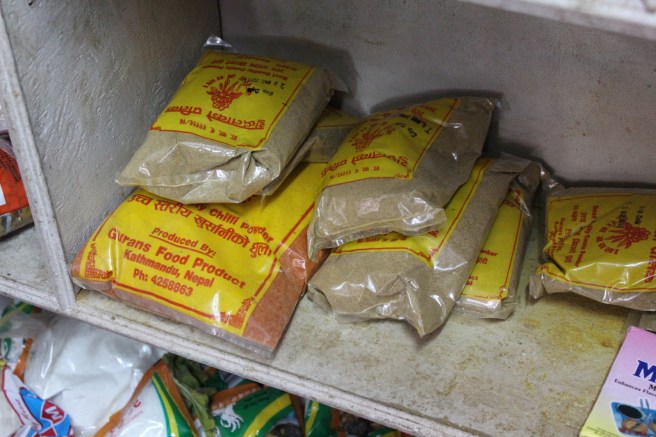
We measured handfuls of red onions, cabbage, green onion, tomatoes, garlic, cilantro… cramming them into a fabric bag Sakun had brought along. I also picked up some spices to use at home – a 200 gram bag cost about 50 cents Canadian, and the deal was too good to refuse.

IMG_2058

I also bought a box of special momo masala spice, for the momo-making parties I’m already anticipating for the near future (like a sushi party, everyone brings a filling!).

Ryan, Carmen and I quickly learned the secret to a good mixed vegetable momo is to make sure everything is cut extra, extra finely. Sakun sent us each back to our cutting boards a number of times, demanding with a laugh that we chop things just a little more. I didn’t mind, though (then again, I wasn’t cutting the onions…), since I realized how much I’ve missed cooking since I started travelling. It felt good to be in a kitchen and making food again.

?????????????????????????????????????????????????????????????????????????

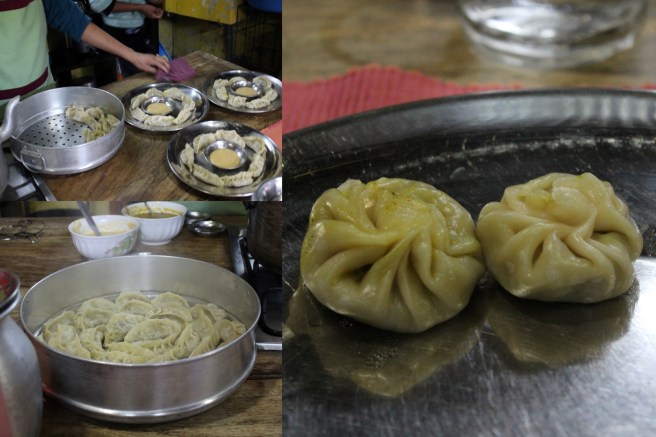
Once our chopping satisfied master chef Sakun, it was time to make and roll out the momo dough. Six cups of flour and a cup-and-a-half of water was what was needed to make the casings for dozens of momos, and leftover dough was used to make chapati, another Nepali roti (bread). We took marble-sized pieces of dough and rolled it in our palms as though forming meatballs. Each ball was then rolled flat with a tiny rolling pin, and tossed onto a central plate for stuffing.

Carmen and Ryan learning how to perfectly crimp the momos

That was the fun/messy/tough part. Sakun patiently showed us how to make the crescent-shaped momos by crimping one side of the dough while holding in the filling with the thumb of our opposite hand. We also made the round momos (far more difficult), with the cute pinched together tops. Usually the different shapes are used to indicate whether a momo is vegetarian or not.

Predictably, eating remains my favourite part of momos. And eat we did. The best part of the meal was that we got to share it with the other Social Tours staff members, and watch their reactions as they took the first bites of our freshly made momos.

The finished product!

After a short lunchtime food coma break, it was time to make dal bhat. Sakun and I took another trip to the market, this time picking up potatoes, green beans, carrots and spinach. One of the essentials of dal bhat is the spice palette, and Sakun had a few jars of turmeric (for the dal), chili powder, cumin, coriander and fenugreek (I had never heard of this before) to season the different dishes. The dal bhat vegetables required considerably less chopping than the momos, and the entire process took about an hour.

Dal bhat ingredients

In the end, the different dishes were the dal, the bhat, tarkari (vegetable curry), for saag (curried spinach), and achar (“pickle” made of tomatoes and delicious fresh green chillies). You’re left with a whole assortment of flavours and plates, all of which combine to make the delicious Nepalese speciality. I was still full from momos, but went back for seconds (remember the rule: always say ‘yes’ to more dal bhat)

All the components of dal bhat, together as one (starting in bottom right and going clockwise, there's the dal, vegetable curry, curried spinach, pickle, and carrots)
All the components of dal bhat, together as one (starting in bottom right and going clockwise, there’s the dal, vegetable curry, curried spinach, achar, and carrots)
Dinnertime! Happy as a clam.
Dal bhat
Dal bhat

I have the recipes for a variety of momos and the dal bhat now, and I can’t wait to re-create both when I get home!