A political portal to the world

(Just the first in a series of posts and retrospectives written and rewritten during and post trek)

A small corner of window at a teahouse in Dzongla has become an unconventional gathering point. The patch of window is positioned right by the teahouse’s front desk, and a large crack in the glass has been covered with faded brown duct tape to keep out the wind.

For now, this single window looks out not only onto the mountains, but onto a changing political scene in Nepal.

This window spot is where a handful of Nepalese sherpas, guides and porters, are getting their election news. It’s November 20, a day after the country’s national election, one that has been delayed several times over the past year. Some background: it has not even been a decade since Nepal became a parliamentary republic, having abolished the powers of the country’s long-time monarchy. Since the first Constituent Assembly elections held in 2008, the country has been repeatedly attempting and failing to write a new constitution.

With this most recent election, it will take days for the ballots to be counted and collected, both by computer and by hand.

But back to that corner patch of window.

IMG_1843

Dzongla is located at 4,830 metres, and that patch of glass is the only place in the teahouse that gets cell phone reception. The election results are streaming through a cell phone that’s been put on speaker. It’s a Nepalese friend of the bunch relaying information from Kathmandu. It will be days before the Nepali Congress party (one of three main parties in Nepal, where there are a staggering 50+ political parties) is declared the winner, earning 105 out of the country’s 240 first-past-the-post seats. The former, post-civil war ruling party, the Maoist Communist Party of Nepal, saw its power wane, and ended up in third place, much to the thrill of my trekking guide, Gopal.

Here in the Himalayas, the Nepali Congress party is the most popular, with people telling me they put more focus on important priorities like building hydro-electric dams (much of the power in the upper altitudes comes from unsustainable kerosene, when there are multiple raging rivers whose powers could be harnessed) and increased access to clean water. One night in a town called Lobuche, a pro-Maoist guide was talking loudly about the party to his German trekking group. The tension in the room could have been cut with a knife. I was fascinated.

While lacking news and updates of my own country’s politics (wireless is possible while trekking to base camp, but it’s often expensive because it’s through a satellite connection), I became immersed and intrigued by the Nepalese political system.

Outside of this political-portal-in-the-form-of-teahouse-window, every night the guides and porters sit around the different teahouse stoves to discuss the day’s ongoings. I don’t understand the language, but I recognize the names of the political parties and the body language that follows the mention of each. I identify with the draw and appeal of ignited discussion, the dragging over of a plastic chair to join the conversation. Will this new Constituent Assembly be able to finally draft a constitution? Or will next year’s trekkers be hearing similar sentiments, more lost-in-translation political musings?

Time will tell, and I’ll be following from home.

I am both grateful and a little sad to have not been in Kathmandu during election day and the weeks leading up to it. Sad in a curious journalist sense. Grateful in the sense that the entire capital was virtually shut down because of a city-wide bandh (strike), where shops, offices, and schools were closed. The morning we left for our trek, our van to the airport was stopped by the military in preparation for political demonstrations later that day. Over the following week-and-a-half, those political protests grew violent, and people were injured. We take our peaceful political system in Canada for granted in so many ways. But to be fair to Nepal, at least national elections are something that everyone talks about, cares about, and feels invested in. Sure the political system here is disorderly, but maybe disillusionment and low political turnout requires a systematic reform just as much as chaos does.

A paper making lesson in Bhaktapur

Selecting amongst Newari handiworks in Bhaktapur is a difficult task. The village in the Kathmandu Valley is known as the cultural capital of Nepal, and its streets and squares are teeming with vendors selling and creating the most intricately designed woodwork and pottery. Bronze singing bowls hum from storefronts and pashminas and cotton change purses blow in the breeze like flags. When it comes to the craftmanship, I admire it all.

?????????????????????????????????????????????????????????????????????????

But in true Hilary form, the paper was what I fell in love with the most. Anyone who knows me even a little bit knows my affinity for paper, colours, and paper crafts. Nepal is famous for making its own special kind of paper called “lokta.” That’s the name for the grassy shrub that grows in the low altitudes of the Himalayas, and its bark is used in the paper pulp. Research is currently being done to try and connect the similarities between the lokta plant and the material used for papyrus paper in Ancient Egypt. The Kathmandu Valley, and particularly Bhaktapur, is known for producing lokta, and there are factories in the town that produce the paper from plant to product, right on site.

One of the factories to do this is part of The Peacock Shop, found in close proximity to Bhaktapur’s famous wooden peacock window.

Heading to The Peacock Shop at the end of my first day in town, I met Suyog, the 23-year-old son whose family owns the factory and paper shop. He was kind enough to give me a tour and, since a paper factory is kind of the ultimate visual experience, I thought I’d invite you along for the ride. This is my first experiment with multimedia while travelling, using a bunch of tools I’m not used to, so excuse some of the quality issues!

I went back to The Peacock Shop the next day and bought a whole bunch of one-of-a-kind items – cards with a local flair (the red flag-like feature is meant to represent the local sari, and the yellow kites symbolize good health in Nepal), and incredible stationary sets.

Some of the beautiful greeting cards from The Peacock Shop

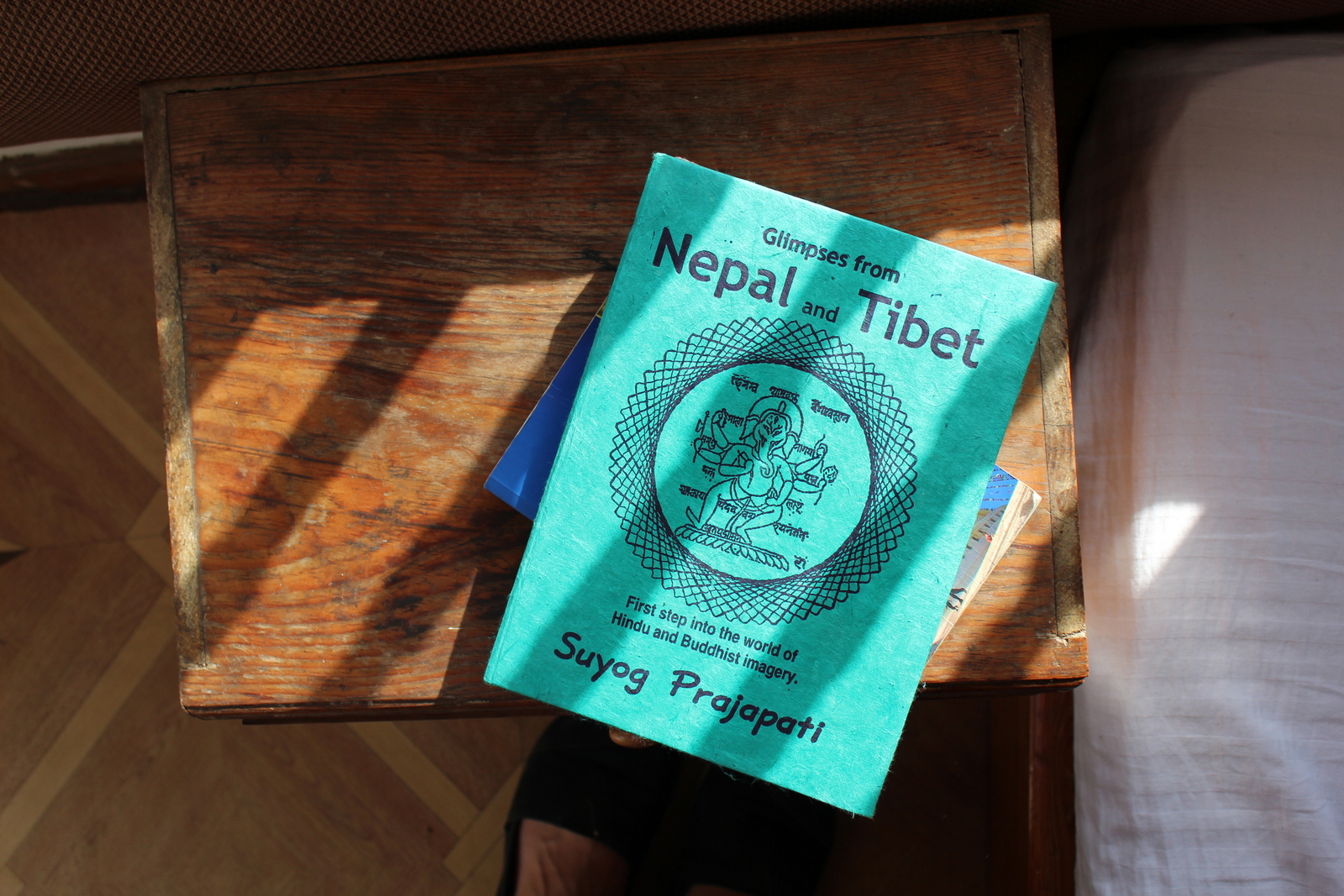
I also got an introduction to Buddhism and Hinduism book that Suyog wrote and printed when he was 17. I have been expanding my knowledge of the iconography throughout this entire trip, and hope this book will further enhance my learning and appreciation of spirituality in Nepal!

IMG_2179

Day and night

Nepal wakes up early.

Or early by most Western standards, anyways. It’s 6:23 a.m. and the red cobblestone streets of Bhaktapur – a medieval municipality east of Kathmandu where I’m spending the next few days – are bustling with activity. The taxi honks that populate the streets of the country’s capital are absent here, but the sound of motorbikes and dog barks allude no one or no place.

The view from my guesthouse window.

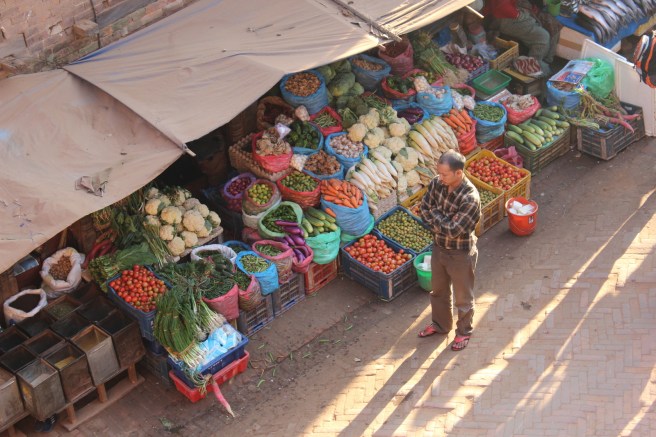
The smell of cooking oil is drifting up three levels from the street. Despite the windows being closed, its scent is filling my guesthouse room, where I sit on the bed, face lit only by the screen of my netbook. Behind me, the curtain is growing brighter by the minute, someone pressing the brightness button on the day at hand. Down below, fruit carts hobble over uneven brick, and a vegetable vendor sells to early passersby. The fish monger has yet to arrive, and for a few more moments, the area in front of his table remains free from the slippery blood slick that almost claimed my grace yesterday.

IMG_2104

IMG_2107

It’s almost winter, and days are short in the Kathmandu Valley. The sun is setting at around 5:30 p.m., blanketing both Kathmandu and Bhaktapur in a thick darkness. In Canada after dusk, it doesn’t get dark, not truly. Our streetlights, houselights, shop lights, business lights, all of the lights (as one may say) remain on, sometimes, absurdly, throughout the night. I never realized how much electricity impacted my perception of the night-time landscape.

Not so, in Nepal.

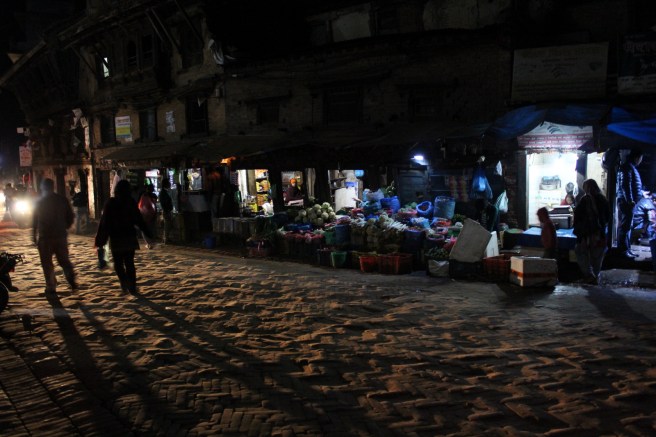
Those same storefronts by my guesthouse, by the light of darkness.

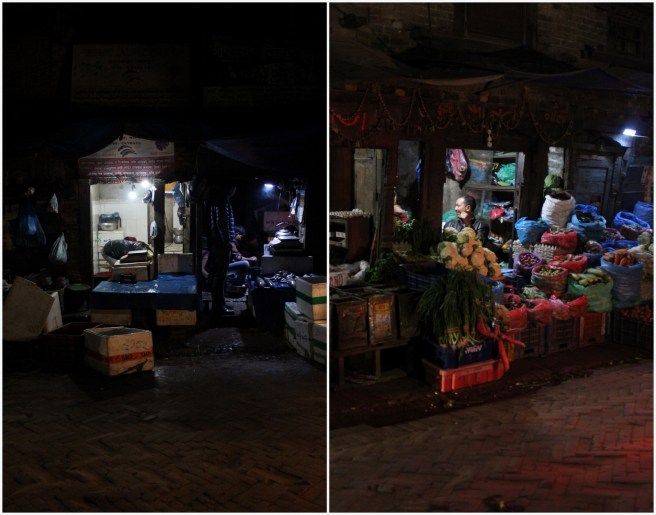
Rolling power outages around the city mean many businesses are lit by candlelight or, like the vegetable vendor across the street, a single light bulb once darkness falls. The effort of that small bit of electricity alone is accompanied by the churning and rumbling of a generator. I take our unprejudiced, unlimited access to hydro, both day and night, completely for granted.

?????????????????????????????????????????????????????????????????????????

On my first night in Bhaktapur, I arranged to have supper with a new friend at 6 p.m. We choose to meet in front of one of the temples in the town’s Durbar Square, a main gathering point where we had both been earlier that day. I was exploring a local paper  factory (more to come) when night fell, and geographic disorientation took heed. All the identifying marks you subconsciously and consciously bookmark disappear as soon as it gets dark. That momo seller on the corner, the craft tables, the King Curd (a Bhaktapur specialty…like a tangy cottage cheese made with buffalo milk. So yummy) shop – all had shut their doors for the day, taking a magic eraser to my mental map.

A street food vendor works by the light of a small generator.

I found my way eventually, carrying my headlamp for both directional purposes and to make myself known to the motorbikers who still roamed the streets.

Outside the heritage portion of Bhaktapur (a portion of about 12,000 Newari-style homes), activity remained a little more vibrant. In the storefronts that were still open, men and woman huddled around the single light source, sitting on the stairs or on the floor, talking or playing chess. I guess you get used to the inevitable darkness of night as a guest at the dinner table.

I’m not sure if it’s because the power outages and early evenings limit work from progressing past the supper time mark (I have a feeling it does not, because Nepalese people are some of the hardest workers I’ve ever met), but it seems like because of, or in spite of it, they embrace every little bit of daylight. Early evening and a lack of power can dictate your schedule, and it feels natural to go to sleep a few hours after dusk, waking up with the sun and the literal rooster crows.

Evening blogging, courtesy of battery power and headlamp light.

PS: I am in the midst of attempting to write about 10 million blog posts summarizing the incredible experience that was my Everest Base Camp trek. In the meantime, I will be continuing to blog about other things, with trekking posts hopefully scattered throughout.

An explanation of Everest and the most mystical flight

Everest. The mother of mountains has been on my mind for as long as I can remember. Actually, I know exactly when my fixation began. It was grade two. My family and I visited Science North in Sudbury, and decided to stop and see the latest IMAX release. One guess as to what that film was about.

After that, I became obsessed with all things Everest. That winter, my best friend Andrea and I spent every recess and lunch hour scaling the rock face behind the old Macleod Public School. It’s icy face shone in the sun, and I pretended it was the Khumbu Glacier. When we slipped, we pushed ourselves further. Just a few more feet to the summit of our mini Everest.

After a few years of letter writing back and forth with the Bluecoats at Science North, I was a certified Everest super-fan. I had posters, an autograph from the IMAX director, and a library card to withdraw a small screen copy of the film whenever I wanted.

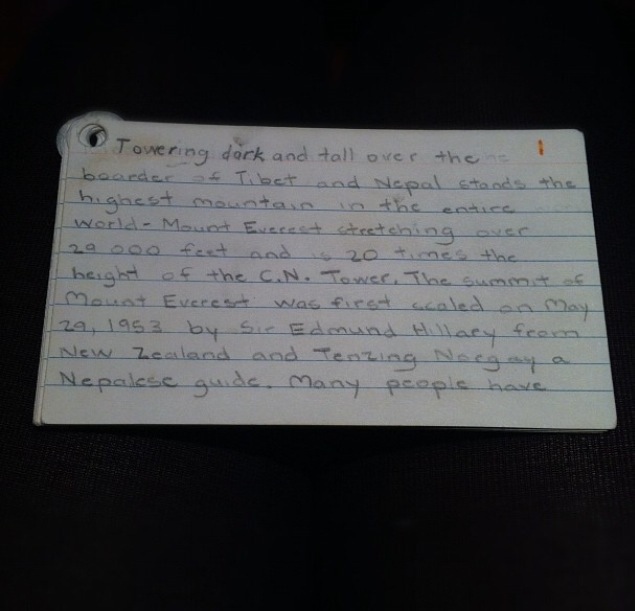
It all culminated in my grade five speech. In elementary school in Ontario, all students were required to develop their public speaking skills in the form of a three to four minute stand up. Speech competitions were serious business: a time to organize back-up cue cards should memorization fail, and practice your time with a microwave countdown. It was also a time for sharing your passions. So I wrote a speech about Everest, using my words to bring my classmates on a journey to the top of the world.

20131112-192751.jpg

ANYWAYS, that childhood obsession, and the fact that I share part of my name with Edmund Hillary , one of the first people to summit Everest in 1953, has meant that visiting Nepal and somehow getting near Everest has been a dream for a long time.

So, snap back to present day. I’ve come to realize reaching the summit of Everest is a feat that alludes me physically, financially and mentally. But…there is Everest Base Camp. At 5,360 metres, base camp is more than halfway to the 8,850 metre summit, and far more manageable of a trek.

On Monday, November 11 at 5 a.m., my 16-day hornet began. Making our way (I signed up to be part of an organized trek for safety and peace of mind) to Tribhuvan International Airport at the edge of Kathmandu, we were met by the organized chaos (a common theme in Nepal, methinks) of the airport, with a pile of people waiting to take the 35-minute, 12-person plane ride to Lukla, deep in the Himalayas where the Everest Base Camp trek begins. Just as my new Canadian friend and fellow trekker, Donny, and I were sitting down to order a morning airport breakfast, our trek company guy, Raj, came bursting into the room. “Come quick! We got you a spot on a helicopter!” It was 7 a.m. and our scheduled plane flight wasn’t due to leave until 10:30 a.m. But what’s both slightly concerning and charming about Nepal is the informal arrangements that are made through a bartering system of networks. Raj, apparently, has some
connections.

20131112-192722.jpg

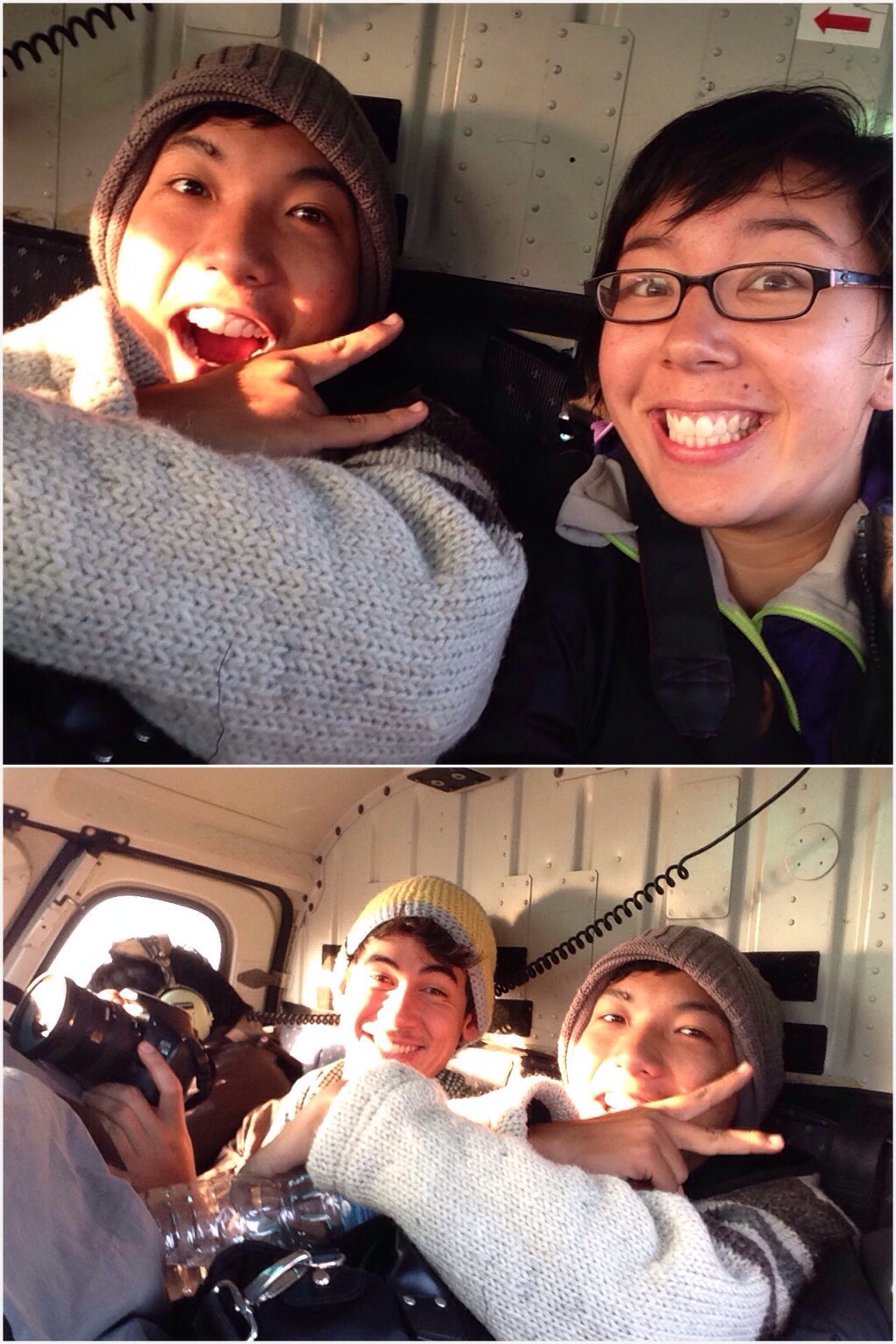
So that’s how Donny, myself and two Nepalese men (including one sweet guy named Sunan, who quizzes us about Justin Bieber, Avril Lavigne, and Sum 41), found ourselves piled into the backseat of a 6-sweater helicopter. Our large backpacks were promptly stacked on our laps, which was good, because there sure as heck weren’t seatbelts!

20131112-192733.jpg

I knew flying through the mountains was going to be an incredible experience. Flying in a helicopter, though, was beyond anything I could have dreamed. Helicopters are like toys – giant bubbles of metal and gas levitating off the ground.

Just like that, we’re off, floating out of the smoggy haze of Kathmandu into the blue sky of the morning.

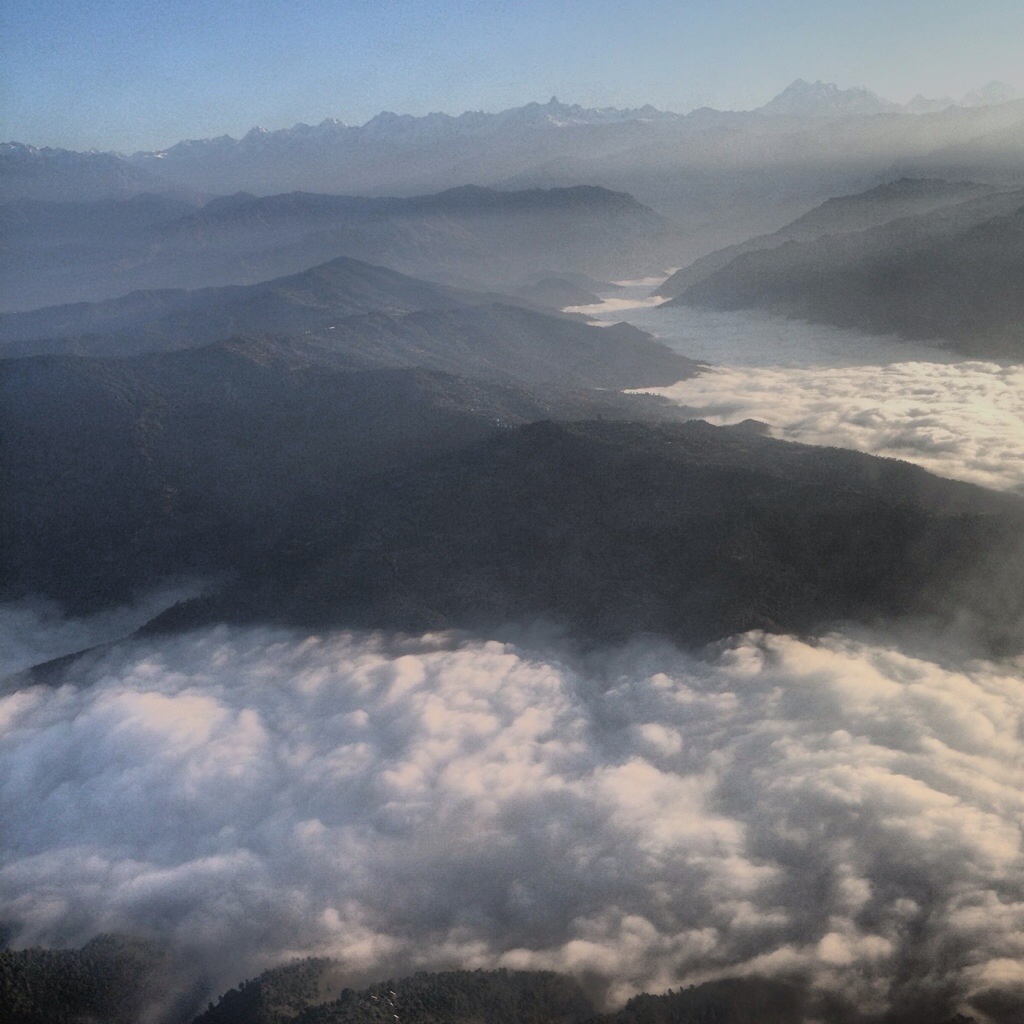
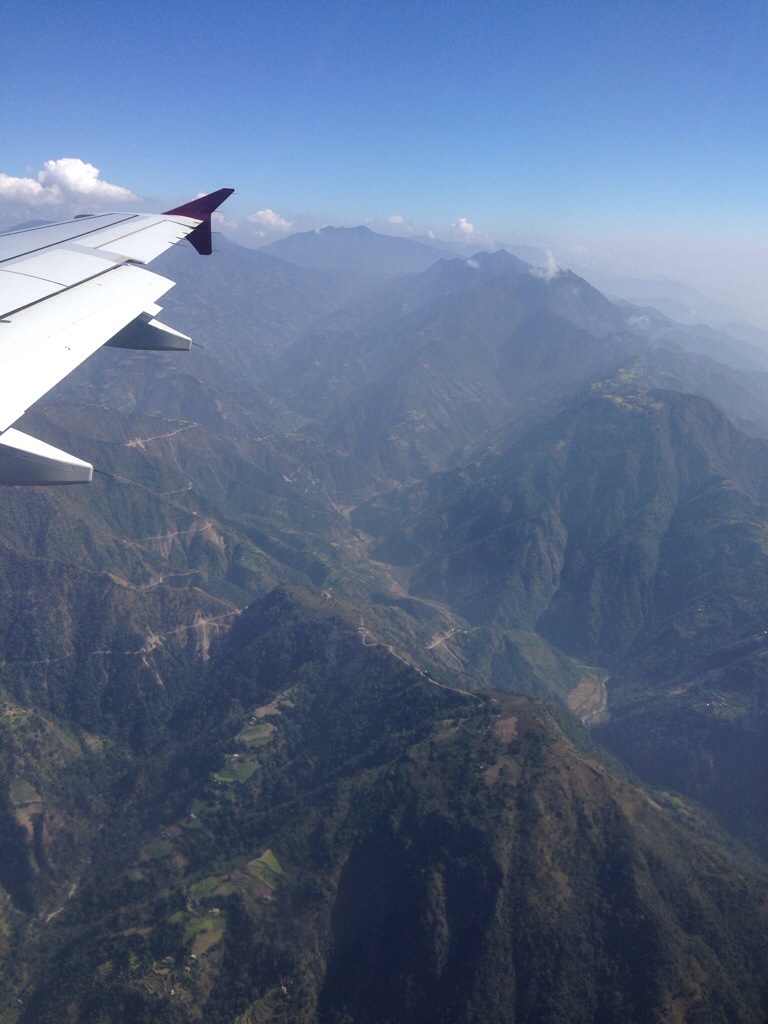
If I thought the terracing of the Mahabaret Range was impressive, I had no idea what to expect on this flight. The terrain of Nepal is otherworldly. Cotton balls of clouds settle into mountain valleys, a basin of the earth filled with vaporized moisture.

20131112-193120.jpg

At some points the terracing is so dramatic it looks as though stepped fungus crawling up a tree. That, or chipped pieces of sponge toffee that has melted onto the surface of the earth.

20131112-193133.jpg

Watching the jagged mountaintops, I’m baffled by the scale of things. These magnificent heights are the bumps on a globe, the geographic raisins that pulled in fingertips with a mysterious gravity. It’s all just so beautiful, and feels like a spiritual encounter, being so close to parts of the planet I’ve only ever seen in photographs.

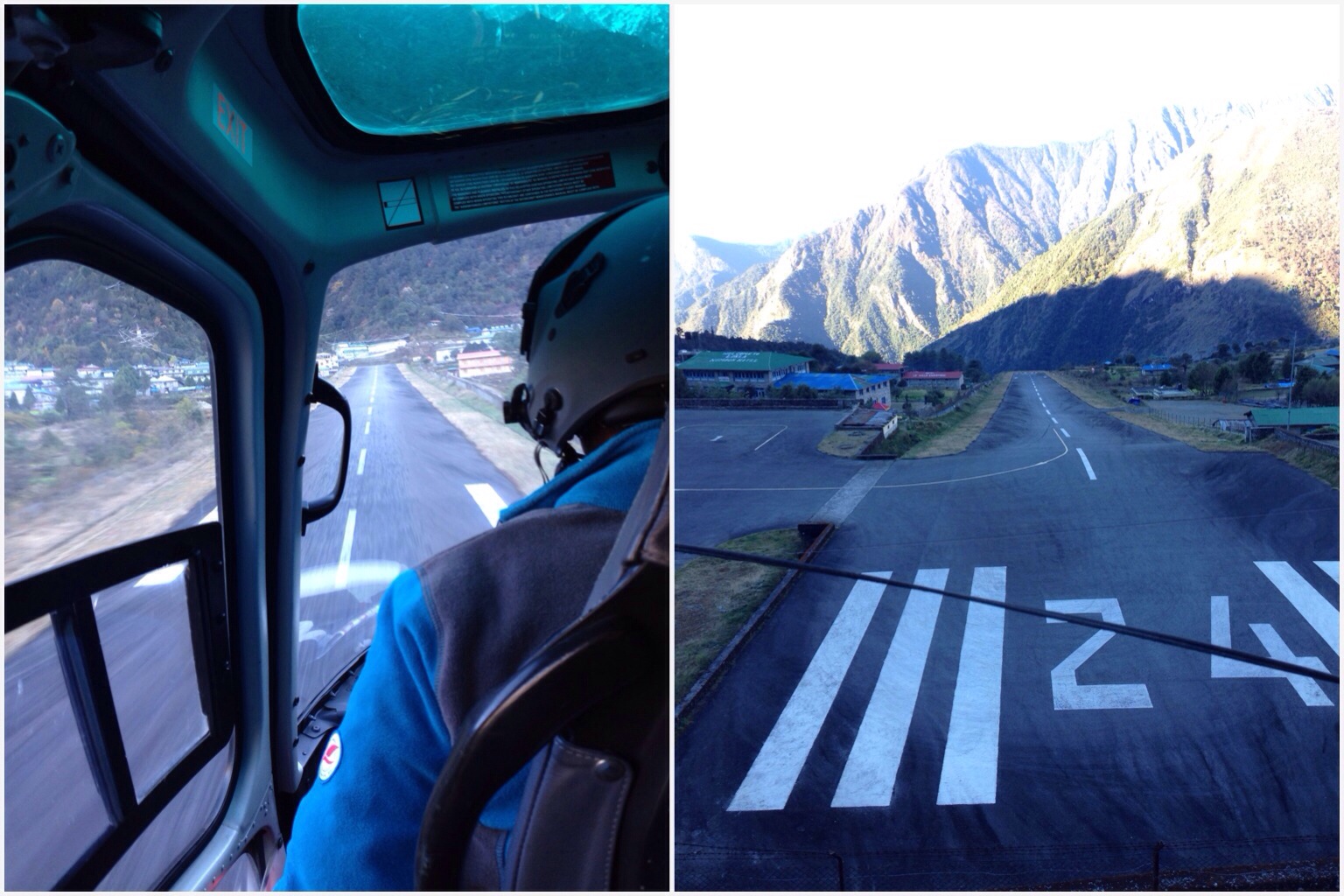
Sunan taps me on the shoulder and gestures out the cockpit window. Lukla sits a the slope in the near distance. A few moments later, Sunan leans over to me and whispers “this is the most dangerous airport in the world.” If I wasn’t so excited from our flight, I may almost be worried.

20131112-192743.jpg

But Sunan has a point. At 580 metres in length, the Lukla runway is one of the shortest in the world. It starts at the end of a cliff, and inclines up in order to both slow income aircraft and give departing plans the ground speed they need to take off, before plunging off the runway drop.

In our helicopter, we land to the left of the runway, the force of the wind being produced by our blades scattering plastic, empty fuel canisters around the strip. The blades do not stop or slow as we climb out of the aircraft. Despite them being well overhead and it not being windy, I hunch over and scurry away.

It’s only 8 a.m., and already my day has been filled with absolute excitement, joy, and wonder. We head off on the first leg of the trek later in the day, but in the meantime, let’s just leave this post off with a “to be continued.”

(PS: I initially wrote this post in my notebook by a wildfire in a tea house in a Himalayan village called Phakding. Life is good)

Also: I’m posting this after day two of our trek. Internet won’t be accessible after this village, so I’ll likely have to do a posting spree when I get back into wifi range. Plus typing out hundreds of words on an iPhone keyboard is tough!

First encounters with Kathmandu

The mountains seemed to open at the end of my four-hour flight from Doha, Qatar into Kathmandu late last week. We entered from the south-west, and flew through the Mahabharat Range mountains, also known as the Lesser Himalaya.

20131110-222706.jpg

Unlike their snow-capped cousins, the Himalayas (which I got my first glimpse of in the north), the Mahabharat mountains are a lush green, their narrow tops and slopes dotted with terrace farms and switchback paths. I had my forward pasted against the window, with 48 hours of travel leaving an oily mark of curiosity. At the altitude we were flying (less than 3,000 metres on the descent), I loved thinking that several of the mountain peaks now reached higher than we were flying. Forget flying over the mountains. Nepal is about being humbled by their size, while flying through their majesty.

Once in Kathmandu, I wasted no time in heading out to explore. I quickly showered away my sleep, sterilized a litre of water (Steripen + Hilary = BFF), and set off on foot.

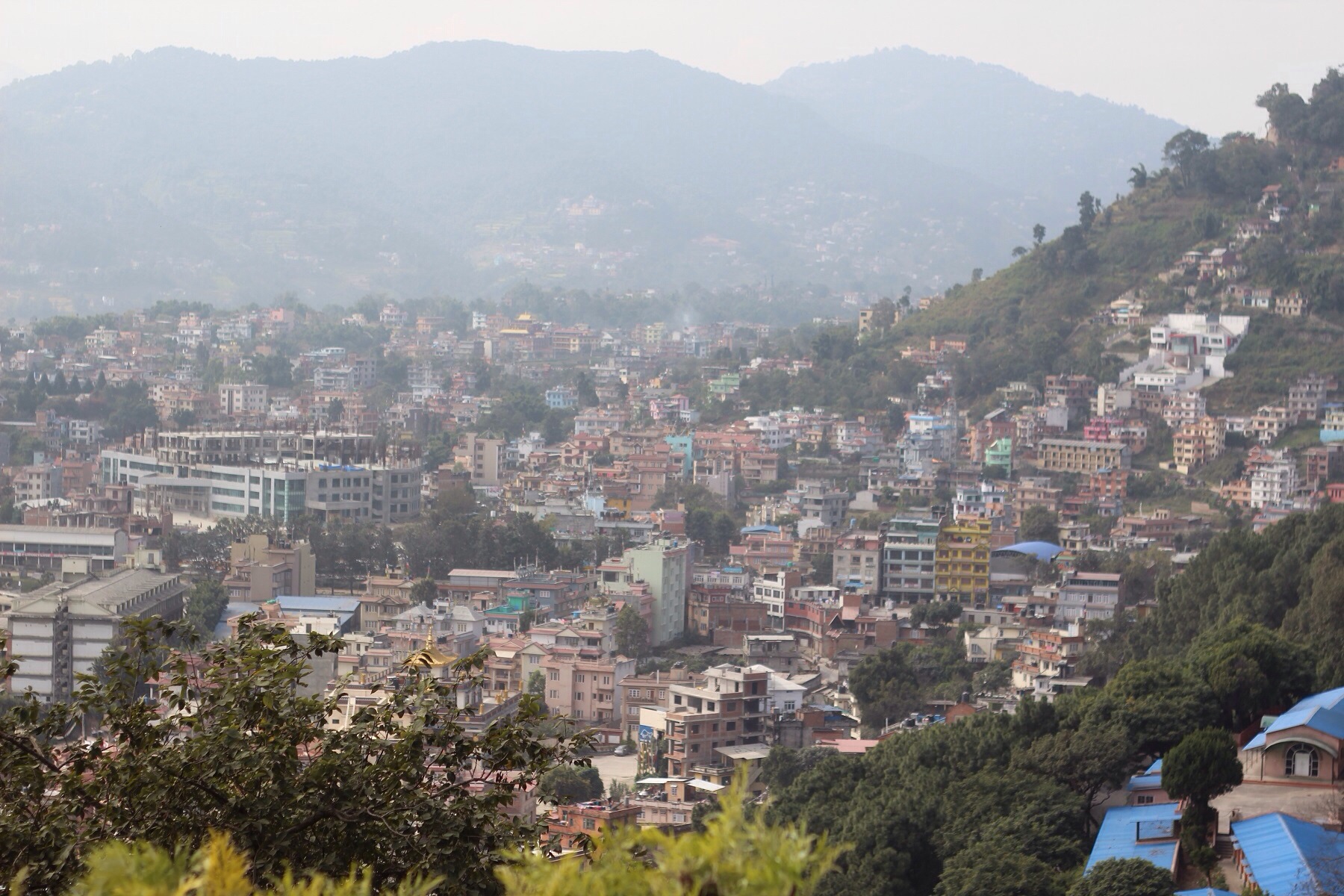
It’s difficult to summarize what it’s like walking through the streets of Kathmandu. It’s a cliche over-used by travellers, but the phrase “an assault to the senses” is not so far from the truth. The city is a cacophony of sounds – not noises, as some may classify, but a collision of new experiences layered in an intricate aural soundscape. At the base, there’s the never-ending stream of honking, from taxis, colourful public buses, and mopeds, weaving in and out of the crowd. Percussive additions fill in what could be silence, as transmissions rumble and engines subsequently stall. The streets themselves are an amusing and incredible example of organized chaos, with each vehicle knowing just how much space it will need to pull around stray dogs, wayward walkers, and each other.

On top of the street sounds, there’s just the general buzz of life – Buddhist monks chanting outside temples containing giant prayer wheels, people calling back and forth across the street in Nepalese, and the occasional political campaign bus (elections in Nepal are being held in just over a week) amplifying its message through two gramophone hood-esque loudspeakers chained on the front and back of the vehicle.

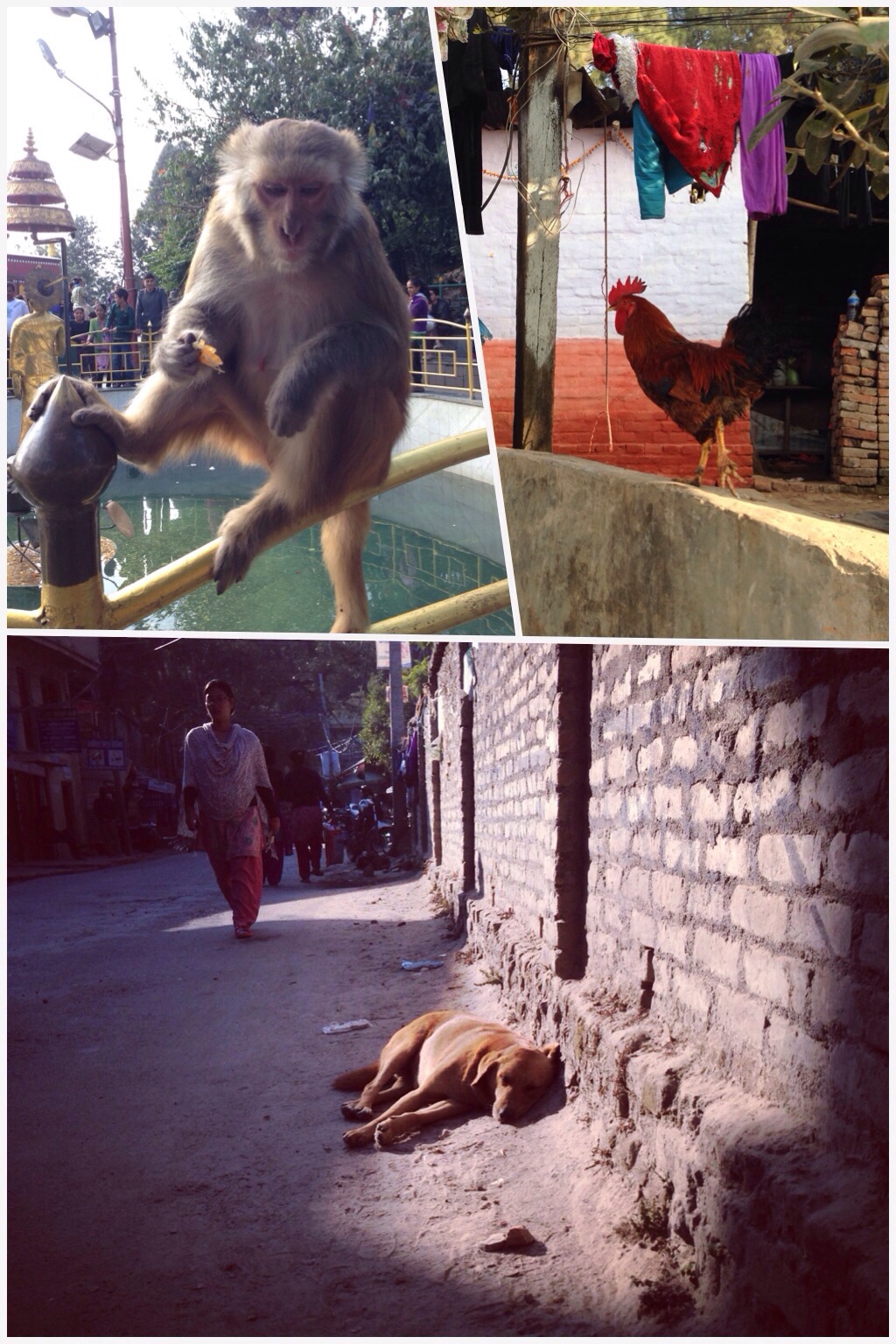
Finally, there’s the sound of animals. There are a huge amount of stray dogs in Kathmandu. Their lean bodies stretch over every surface of the city, slumped and asleep under benches and in the middle of roads. Domestic animals look unusually out-of-place, with their clean bodies, fluffy fur and leashed necks. Across the street from my hostel, a dog sits within a cage, within a fence. Freedom, I feel, is not a familiar sensation for these pets.

20131110-222329.jpg

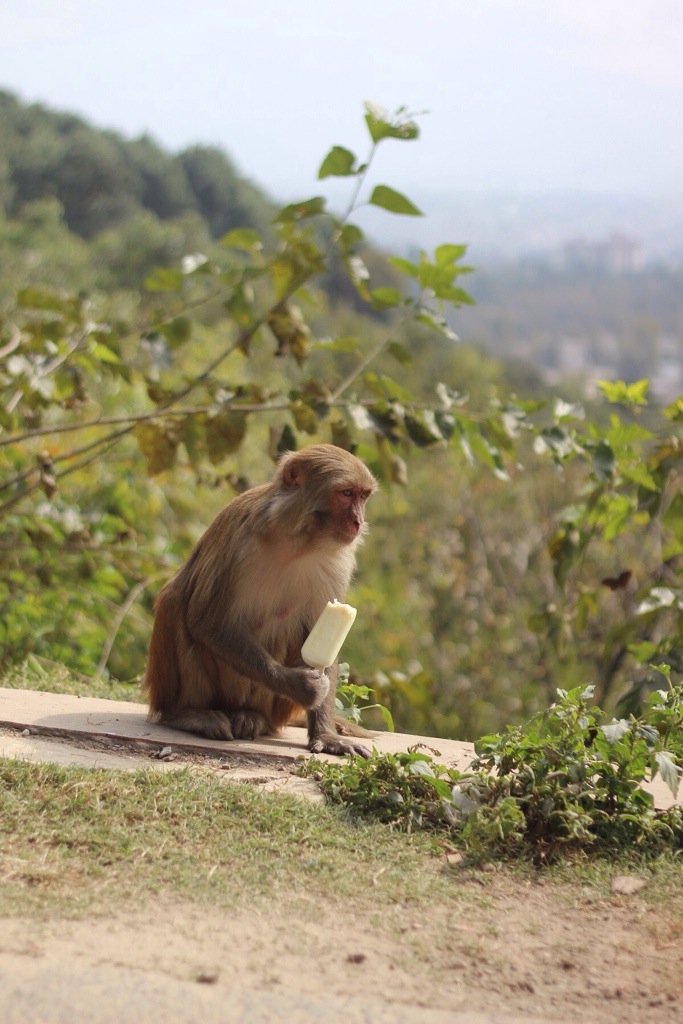
And what would initial encounters with Kathmandu sound be without mentioning the monkeys? They’re everywhere – perched on power wires like pigeons, begging for food in people’s front gardens, and eating popsicles on the road up to one of the Buddhist temples. On my first night in town, I was sitting on the main staircase up to Swayambhunath, one of the most sacred Buddhist temples and stupas in Kathmandu. As I sat there scribbling in my notebook, two monkeys started to quibble, and at least 20 more soon joined in, their shrieks ringing off the concrete idols on the stairs. I jumped to my feet, and did everything I could to stop from showing the panic in my eyes (probably didn’t do a very good job). What was a seemingly shocking experience for me turned out to be quite normal, and people watched with amused eyes as the monkeys’ hairy backsides turned from bound to blur.

20131110-222420.jpg

Now, just two days into my stay in Kathmandu, these things have started to fit into my idea of everyday life. Isn’t it incredible how quickly we’re able to normalize experiences, and have them adapt to become our new base level norm? For the past few mornings I’ve started taking hour-long walks, both to re-align my senses after sleep, and remind me at the outset of my day how lucky I am to be wandering around a new place.

20131110-222409.jpg

On Sunday morning my walk twisted me around orphanages and international schools, across a ring road and past a military compound. I felt alert and alive, my nostrils filled with equal parts incense and burning garbage. The morning smog settled over the crumbling backyards like golden hour light.

20131110-222354.jpg

A few other notes: While out for a walk earlier in the week, my new Australian friend, Nickki, and I passed by a mango tree. We were, I guess you could say, surprised by its presence. We’ve both eaten mangoes plenty of times, but have never seen where they come from. What does that say about the disconnect we have with the food we eat? In Kathmandu, there’s much more of an immediacy with food. Wandering down stony back lanes, many of the yards have medium-sized garden plots, where leafy greens sprout out of the dirt. Shopkeepers sell vegetables in front of their small storefronts on overturned pieces of plywood. Nepalese men carry buckets of momo (dumpling) filling up steep stairways, on their way to temple restaurants.

20131110-222428.jpg

Finally: the people here are so lovely. Everyone I’ve encountered so far has been so accommodating, patient, and positive. From taxi drivers to hostel staff to people on the street, there’s a feeling of ‘make-the-best-of-it’ mentality. People are so curious about Canada, too, and one shopkeeper told me the other night that he visits the country in his dreams.

20131110-222343.jpg

A successful first few days in Kathmandu. There’s far more to write, but I’m not sure there’s time right now. My life takes a jump in another direction as of Monday (tomorrow) morning at 5 a.m. – I’m headed out for three weeks on a trek to Everest Base Camp! Outdoor adventures and childhood dreams, ahoy!

20131110-222455.jpg