Playtime.

Hello all! I have just returned to Kathmandu after spending the last week-and-a-bit in a rural village called Gatlang. I first travelled through Gatlang right before Christmas when trekking the Tamang Heritage Trail, and have since harboured a bit of a crush on its isolation, natural splendour, and kind people. When in Gatlang the first time, I stayed at the Parpati Kunda Home Stay, with Tashi Lama, Reyjalmo, and their five daughters: Phurpo Mendo (14), Sita (11), Dawa Mendo (eight), Phurpo Dolmo (four) and Nima (eight-months-old). They were one of the most lovely families I have ever been fortunate enough to meet.
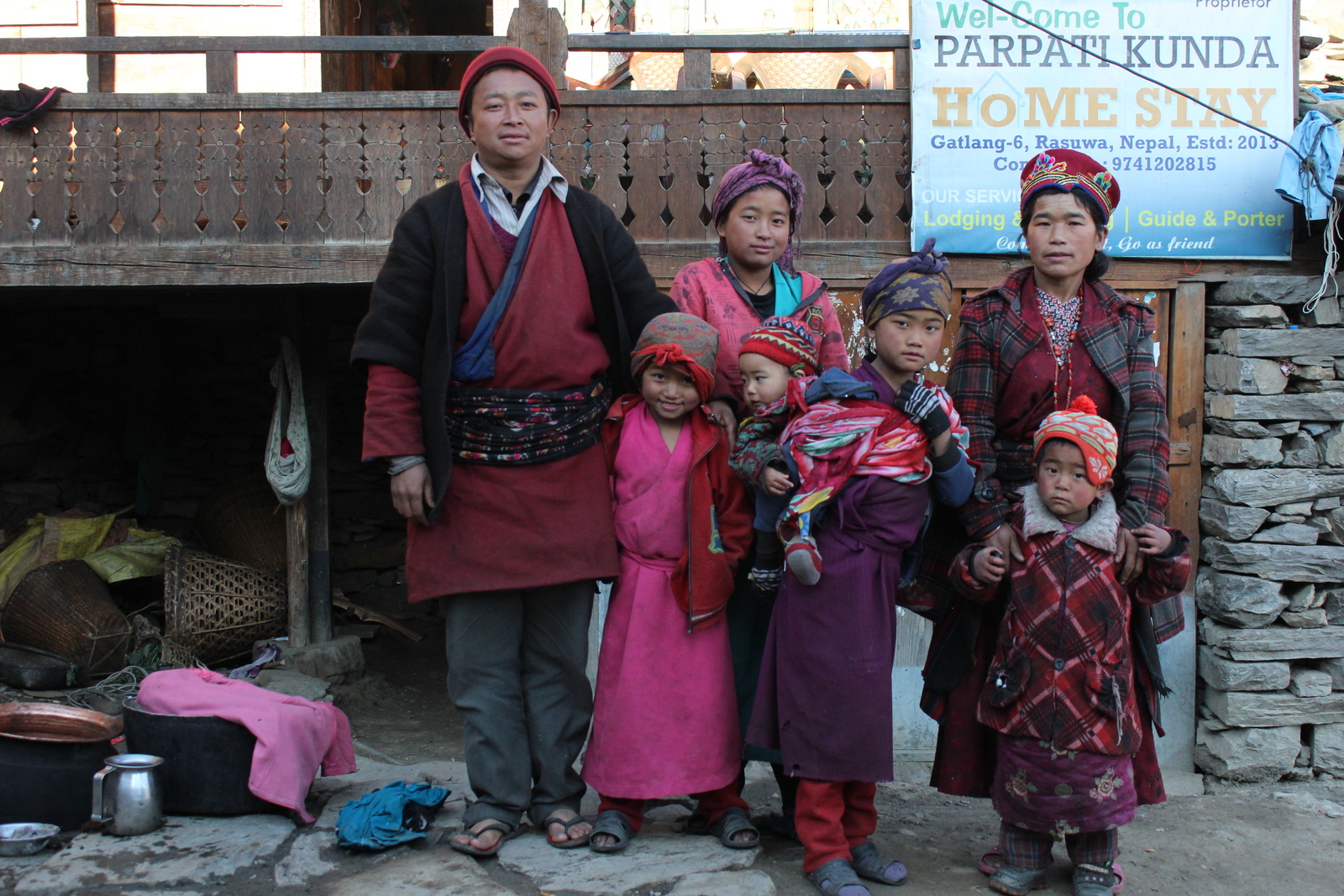
The Lama family, in front of their Gatlang home

While staying with Tashi, his two brothers, Anil and Santosh, said they were interested in creating a website for the home stay and the village, but had no idea how to do it. Long story short, that’s why I was in Gatlang again. Many posts will be written over the coming days about my time spent there – expanded versions of essays and ramblings scribbled in my Moleskine, pages curled by the heat of the fire. In the meantime, though, here’s the first on a concept we all know and love: playtime.

Back at home, I think we’re doing playtime all wrong.

I’m coming at this not as a mother or a teacher or an older sister of a small sibling, but as someone who used to have a hell of a time playing. Inside, outside, in the bush, on the rocks – when I was a kid, playtime was dirty and creative. Knees looked like battle zones; scars from running (and subsequently tripping) with Popsicles, legs bruised and bumped from too many sessions of hide-and-go-seek tag. We were The Generation of kids right before the Internet became a household name. As such, we experienced recess, after school neighbourhood play dates, and long summer evenings in a way that did not involve Farmville or an early onset of carpal tunnel from smart phones. It helped that my parents were adamantly opposed to anything that resembled a game console (“but mooooom, how am I ever going to get better at Donkey Kong?!”) and that I remember them having to make a suspicious number of phone calls just as I got connected to my dial-up internet-enabled Neopets account.
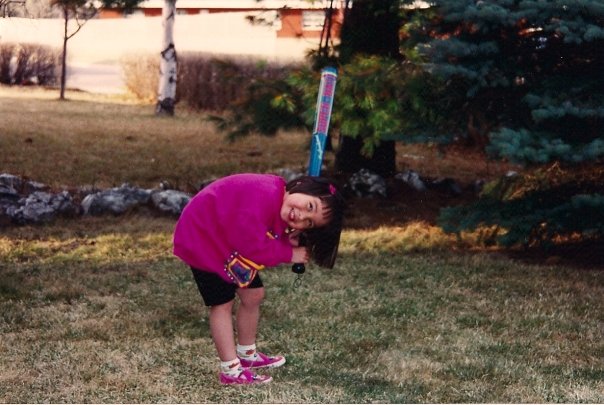
Ok, not the best example of be engaging in childhood play, but the best one I had access to from Nepal...
Ok, not the best example of be engaging in childhood play, but the best one I had access to from Nepal…

Point is: when I was a kid, playtime was more free. That sounds stupid, and it’s hard to explain, but it’s true. Yes we had some play equipment in our school yards, but for the most part, we were left to our own devices to create something to do. Hence the climbing of icy rocks to train for my future Everest summit attempt, the use of dead trees at an old Macleod Public School (Sudbury reference, folks) as teeter-totters, etc. etc. The most fun I remember having at recess was when in grade three, for a number of consecutive lunch hours, my friends and I pretended to be cats, and ran on all four through the bush area next to my elementary school.

Playtime was messier, but it sent our imaginations to other places, it created bonds between kids, and it taught us that if we fell over and scraped our elbows, we needed to get back up again.

Maybe I’m out-of-touch with the reality of playground politics today, but it seems to me as though kids in the Western world aren’t having so much fun anymore. Or maybe it’s that the idea of fun has been redefined, to include concepts like iPhone emojis and Facebook. Whatever it is, playtime seems less focused on the imagination/collective side of things, and more based on established-play-structure/individual ideals.

Now that we have that rant out of the way, please accompany me to Gatlang, where, as I mentioned, I have just spent a week surrounded by a household and village of young children.

Dawa Mendo, probably post-tickle-fest.

I was looking forward to returning to Gatlang for many reasons, but one of the main ones was to see the Lama family again. I had all but adopted Phurpo Dolmo, the four-year-old, last time around. We had worked up such a playtime rapport that she insisted on calling me “ama,” which means “mom” in Nepali. In December, Phurpo Dolmo’s life revolved around a single yellow balloon.

When I returned this time, I wanted to bring something for Phurpo Dolmo and the rest of Tashi’s daughters. Hidden in the zippered depths of my backpack was a 50-pack of balloons (I didn’t even have to buy them…turns out Marlon was carrying an extra bag!), as well as a large pad of drawing paper, crayons and pencil crayons that I got at a convenience store in Kathmandu.

That first night in Gatlang was a party, in the most innocent and heartwarming of ways. Each of the girls chose a balloon (all different colours, of course), and the fun that ensued was electric.
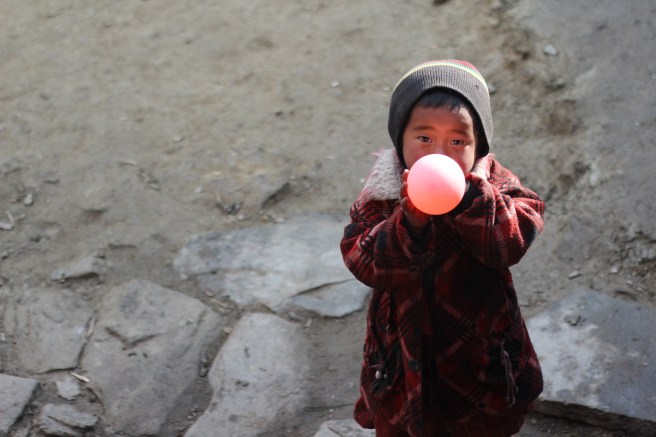
Phurpu Dolmo + her new balloon

It was one of the most uninhibited and pure joys I have ever witnessed. Four children (Nima sat in Reyjalmo’s arms chewing on her balloon) laughing breathlessly as they try desperately to not let their newly-filled balloons touch the ground of their home. (When we were kids, my brother and I would pretend the carpet in our living room was balloon-consuming lava. Turns out the stakes are raised when there is a legitimate risk of your balloon landing in the large fire hearth used to cook meals.) The happiness and energy in that room was contagious. We had to start tying the inflated balloons with a string because the kids wanted to inflate/deflate them so many times.

The next day, word had spread amongst the children of Gatlang. I woke up to a yard filled with kids, all yelling “one balloon!!” whenever they saw me. Soon, there were balloons everywhere. I felt like I could have done a census on the number of children in Gatlang based on the number of balloons doled out.

My balloons bring all the kids to the yard

Walking around the village later in the afternoon, every kid I saw had a balloon dangling from their lips, huffing and puffing into it, and subsequently letting it go, the coloured piece of latex spiralling through the air and into the dirt. I was amazed by how something so simple could keep kids entertained for such a long period of time.

?????????????????????????????????????????????????????????????????????????

Over the next few days, I witnessed many more examples of what I consider “real” playtime: Tashi’s daughters colouring on a pad of paper, rather than an iPad; Phurpo Dolmo’s afternoons spent successfully convincing me to pick her up and spin her around like a merry-go-round. A favourite game involved me sitting, either Phurpo Dolmo or Dawa Mendo on my lap, while we pretended they were on a roller coaster, me making creaky wooden roller coaster sounds as I slowly moved the kids “uphill” and sent them plummeting over the precipice of the imagined peak. On the last night, the girls fashioned toys out of single shoelaces and pieces of wood they had found out front.

It was playtime free of the liability worries that stifle playtime at home. It was playtime where children wave pieces of firewood like swords, and where mud and rocks may not be the same as a swing and slide, but kids make do. Parents aren’t always watching like hawks (not to mention hovering like helicopters), not because they don’t care, but because they trust their kids and know that a few minor bumps and bruises aren’t a cause for concern, but rather a valuable lesson. Fantastical games and stories flourish in a playtime that’s not constrained by fences and rules.

Sulhav, one of the three-year-old boys in Gatlang.

The Western playgrounds of today are literally designed to minimize liability – can we please stop trying to architect fun, and instead just let it happen organically? This is a plea to stop blanching school yards of trees, rocks, hiding spots; kids are meant to climb and jump and leap, and yes, sometimes even get hurt. Maybe I will feel differently when I’m a parent, but I believe the best play-thing you can give a kid is an imagination.

In Gatlang the kids are scrappier. The hands and clothes and faces are so dirty. But the laughs and smiles come generously. Creative and innovative. Simple.

It’s playtime, the way playtime is meant to be. Children, as children are meant to be.

Lumbini: Buddhism and bicycles

Before we begin, a cheater’s guide to Lumbini, compiled from the Internet as well as a handy pamphlet I currently have sitting on my lap.

Lumbini is in the southern-most part of Nepal, mere kilometres from the border with India. The village attained its claim to fame millenniums ago, when Prince Siddhartha was born in the shade of a local Bodhi tree. Prince Siddhartha is probably better known by his other name: Lord Buddha, and his eventual enlightenment represented the advent of Buddhism as we know it today. Nowadays, Lumbini is one of the holiest pilgrimage sites for Buddhists world over, and attracts thousands of Buddhists and tourists every year.

Cleaning time: The giant Buddha statue at the entrance to the World Heritage Site.

For me, Lumbini came in equal parts Buddhism and bicycles. Just in front of the strip of hotels and guest houses near the bus park in Lumbini are a handful of bicycle rental shops. Both Marlon and I had read that the best way to explore the flat grounds of Lumbini were from the saddle of a bike. Not surprisingly, a Dutch girl and a Canadian bicycle-enthusiast were 100 per cent okay with. After all, the last time I rode a bike was in the fall, and I was dying to get back behind the handlebars of a two-wheeled steed. Walking up to one of the bicycle shops, we were immediately accosted by two young boys, both of whom looked to be about 12-years-old. They were from competing shops right next to one another. But puberty does not a good bike rental salesman make, and these preteens jibed back and forth with expert skill, battling for our business. Eventually, we settled on two pink cruisers, one from each shop. The boys looked satisfied, and after giving the brakes a quick test, we peddled off to explore.

Bike gang.
Bike gang.

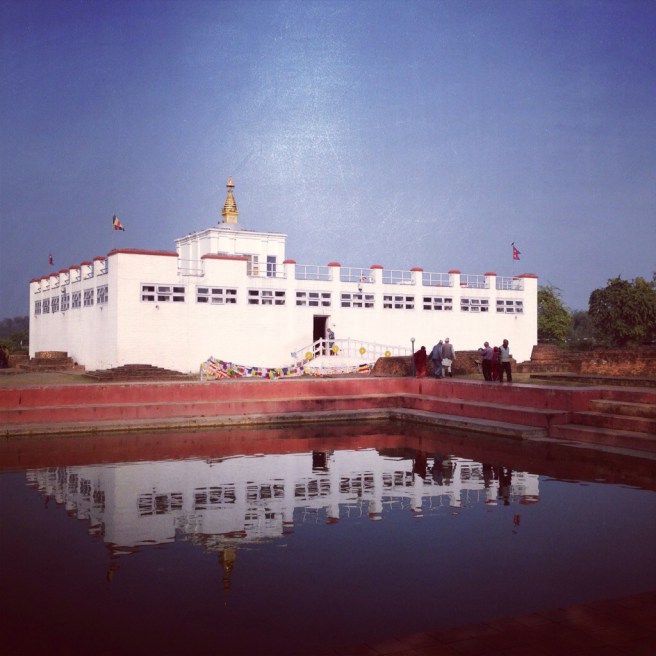
Part of Lumbini rests within a World Heritage Site in the centre of the town. That site is circled by a dusty brick pathway, containing large ponds that look like moats around the main complex. This path is the closest thing I’ve seen to bike path in Nepal (mountain bike trails excluded), and I joyously rode along it, revelling in the warm afternoon sun. From the path you can see the Maya Devi Temple from almost every angle. The temple is a tidy white building, the walls of which enclose the remains of former temple foundations, some as old as the 6th and 7th Century B.C.

20140110-211000.jpg

The Maya Devi Temple is the famed birthplace of the Buddha. Inside, a marker stone has been framed in plexiglass, its presence representing the exact spot where his birth is said to have taken place. I wait in line to pay tribute to the spot, and notice I’m standing behind half a dozen or so people, from all different nationalities, pushing to do the same.

It’s then that I really grasp the significance of Lumbini and the importance of this specific place. Lumbini is a place of origin. Like Jerusalem for Christians or Mecca for Muslims, a visit to Lumbini means going back to the place where it all began – a place whose past events have the influence to shape lifetimes of beliefs. That was something pretty powerful, and I tried to look at the rest of the afternoon through that lens. A tourist stop for us, a pilgrimage for others.

Leaving the Maya Devi Temple, Marlon and I wandered through the peaceful grass gardens of the site, padding around softly in our socked feet. At the start of the garden is The Puskarini, the pond where Maya Devi bathed before giving birth to the Buddha. I can feel my bones creak and ache as old men and women kneel from the terraced steps to splash their heads with the holy waters.

20140110-210951.jpg

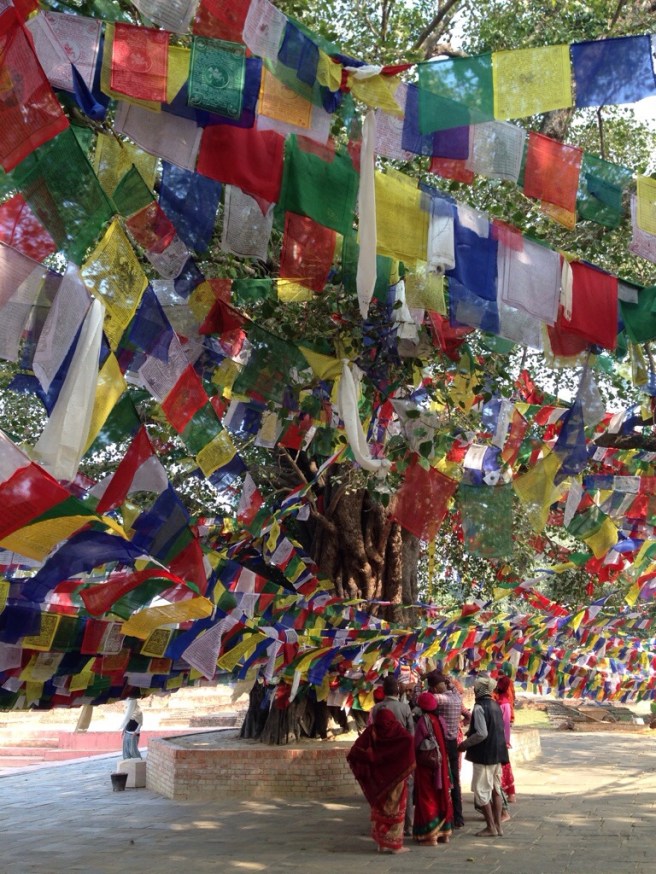
Just a little further away is a tall tree that has a small temple carved into the base of its trunk. The bark is orange and red from the powder used for puja, and marigold petals cling to the tiny idol inside. Hanging from this tree – and every other tree in the immediate area – are more strings of prayer flags than I have ever seen. They’re tangled in the branches amongst the leaves, and the red, blue, yellow, green and white squares of polyester and cotton form a spectacular rainbow hanging above our heads. Burning incense tingles my nostrils as I take a deep, relaxed breath.

20140110-210642.jpg

20140110-210627.jpg

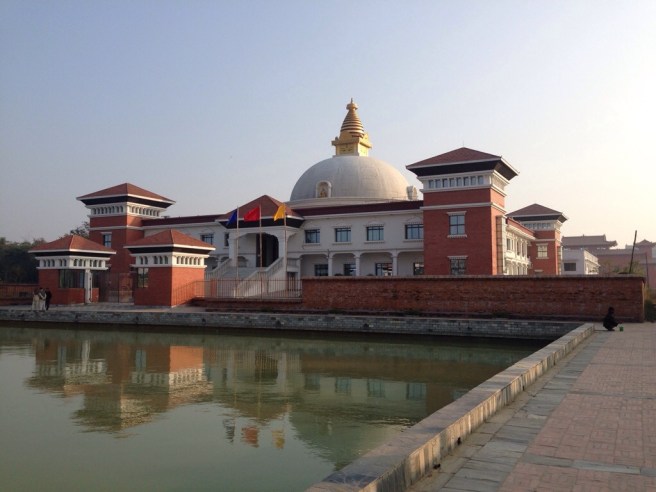
The World Heritage Site in Lumbini was really just the start of our explorations. Surrounding Maya Devi and that circular brick pathway sit the east and west monastic zones. Within these zones are more than 15 monasteries, representing countries from all over the world. From Thailand to Austria, China to Sri Lanka, all have constructed centres in which people can base their meditation. I was surprised by the obvious showiness and extravagance of the buildings, given the principle of Buddhism to separate life from material objects. Regardless of this anomaly, I had a great time biking around the different monastery sites, admiring the uniqueness and beauty of each.

German monastery and grounds - by far the most impressive.
German monastery and grounds – by far the most impressive.

20140110-210715.jpg

20140110-210724.jpg

The rest of the afternoon was spent blissfully cycling around the rest of Lumbini. A kilometre-long central canal connects the World Heritage Site and the monastic zones to the new Lumbini Village, and that became our bike route of choice.

This is the Lumbini Museum, that sits at one far end of the central canal. Architecturally, it was love at first sight.

Eventually the sun started to set over the flat fields of the Terai, a glowing ball of red repelling against the approaching dark sky. Biking at dusk remains one of my very favourite things.

I wouldn’t say I was feeling enlightened after my afternoon exploring Lumbini, but I sure was damn happy. For now, that works for me.

Splish splash, I was taking a bath (now with more elephants!)

In a trip that’s been made up of daily adventures, new lessons, and wild explorations, I know that the morning of January 8 will stand out as a highlight.

03-IMG_7050

The morning started off slowly. In anticipation that today’s weather would be chillier and misty, a la day of the jungle walk, Marlon and I bundled up. I walked out of our room wearing a long sleeve shirt, windbreaker, scarf, and my trusty navy cargo pants. First on the agenda for the day was to go watch elephant bath time, the daily ritual in which half a dozen elephants are scrubbed down on the shores of Sauraha’s Rapti River. We had both brought swimsuits in anticipation of having the chance to get involved in said elephant bathing, but opted to leave them off. It was winter, and we had accepted our role as passive observers in the bath time of the jungle giants.

Walking down the dirt road to the river, Marlon and I ended up behind two elephants and their mahouts (caretakers). One of the mahouts looked down at us from his cushion perch atop the elephant, and asked if we wanted to go for a ride. “Uh, OF COURSE,” we both responded, without even having to look to each other for assurance (because really, how often do you get a chance to ride on an elephant?!).

20140108-164308.jpg

20140108-164322.jpg

Marlon got on first, and after lifting her high into the air, the elephant continued padding her way down to the riverbank. I walked behind, documenting everything on my camera, and in turn walking through a jet stream of elephant fart that was fired in my immediate direction. Outside the release of gas, the movements of an elephant are beautiful. Seeing its muscles stretch and contract as its legs moved forward, I’m once again blown away by the phenomenal creatures that live on this planet.

Down at the beach side, Marlon hopped off, and I climbed on (a process about as ladylike as trying to get back into a kayak in the middle of a lake), grabbing onto the rope around the elephant’s neck, the one that loosely served as the rein for the mahout. I was surprised by the roughness of the elephant’s hide, thick skin like nothing I’ve ever touched before. Protruding from that skin were tiny, thin hairs, which prickled and tickled my legs. The elephant’s ears flapped against my calves.

So excited!!!
So excited!!!

When I got down, I was already on a first-time-on-an-elephant high. The mahout looked at Marlon and I. “Want to bathe the elephant?” he asked. This is where the brief moment of hesitation got us, considering how inappropriately dressed we were for such a job. But once again, I repeat my earlier sentiments: how often do you have the chance to ride an elephant, not to mention help bathe one? So we said yes, and threw down our purses, jackets, shoes, and cameras in anticipation for a soaking good time. Clothes dry and sand can be showered off, but the impulsive excitement of that moment is one not easily duplicated.

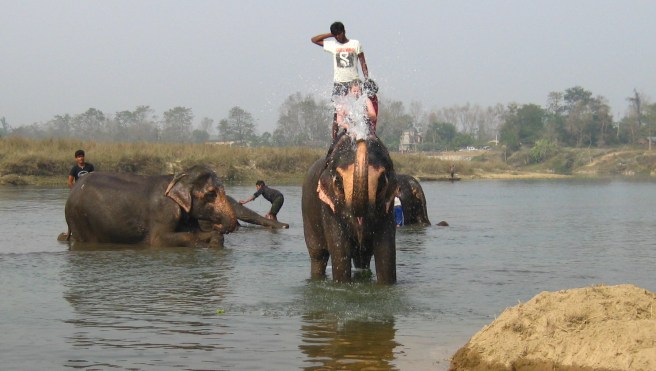
Marlon and I again climbed onto the elephant’s back*, and we lumbered into the shallow shores of the Rapti River. The caretaker splashed Ellie a few times, before she dropped into the water and rolled onto one side, a movement neither Marlon nor I was expecting. Down we tumbled into the warm waters of the Terai, with a splash that made us wonder how we ever thought we might get out of this experience even partially dry.

IMG_7069
See that splash? That is us.

We laughed and laughed, thrilled and soaked to the bone. Climbing back on Ellie, the caretaker yelled out a phrase in Nepali, and before we knew it she had filled her trunk with water and was using some of the 40,000 muscles (!!) to send a noseful of water in our direction. I giggled like an overjoyed child, and even the constant bombardment of water couldn’t wash the smile off my face (though it tried, really, really hard). Hey, it beats coffee when it comes to waking up in the morning.

After we had our bath on the back of Ellie, she lay down in the water and we used sponges and river water to give her a proper clean off.

All washed up
All washed up

I’ll let the photos illustrate the rest of bath time. I need to go and check if my pants are dry yet.

08-IMG_3067 - Copy

07-IMG_3061 - Copy

04-IMG_7057

Marlon looking badass

*The elephant will hereby be known as “Ellie,” as Marlon and I have begun using alliterations to name our animal friends, including (but not limited to) Sally the Salamander and Carmen the Cockroach.

The space between two places

This post is inspired by the afternoon I spent at the Tibetan border in the north part of Langtang National Park. The space between two places is that of the Bhote Kosi river, the body of water currently separating Nepal from Tibet. That space is in the midst of being closed, and a new, Chinese-funded bridge is slowly stretching its trestles across the river. Its completion will mark the start of a new over-ground link between China and India.

I was so struck by this construction project, and its possible implications, that I scribbled this post in my Moleskine shortly after seeing it.

Being in Nepal has provided a thousand-and-one answers to the question I was asked countless times before I left Canada: “so, why Nepal?” But before I was provided those insights, there were a few reasons I had come up with in my mind. One of them was Nepal’s crucial positioning smack between China and India, two of the fastest developing countries in the world.

1-IMG_2712
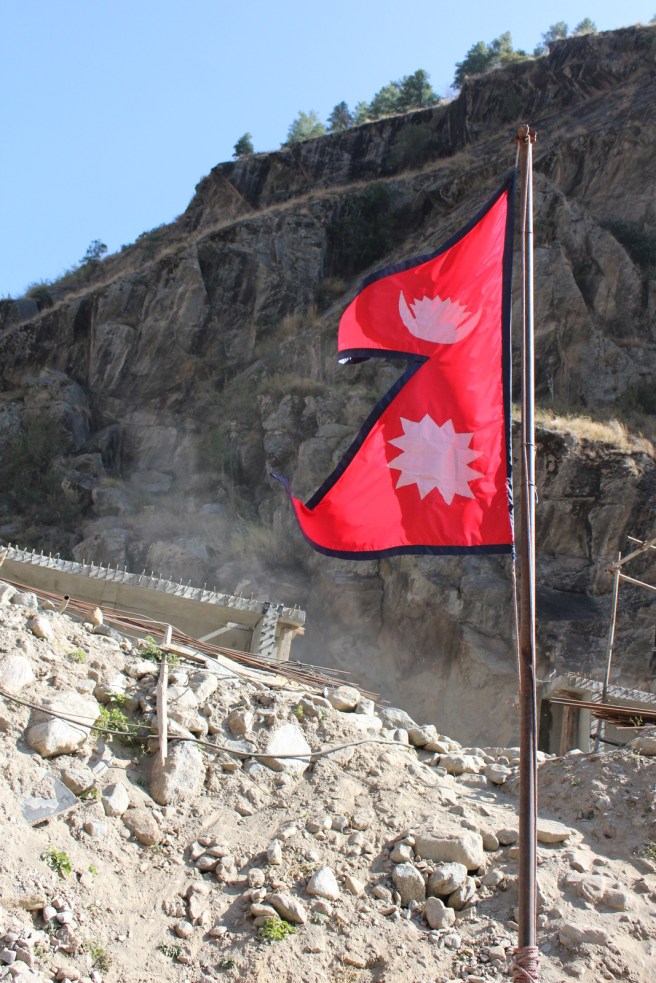
Amidst the rubble of a construction zone, a Nepali flag marks ones transition from Tibet into Nepal.

Soon to be connecting those two places is a road: a new, Chinese-constructed highway that spits out of Tibet and runs along the Bhote Kosi river, It runs past the homes of Tibetan refugees, and will connect the country with another road that leads deep through the heart of Nepal, branching off further still onto roads that eventually lead to India.

The current suspension bridge connecting Nepal and Tibet (left); a traditional Tamang village, just down road from the new bridge (right)

Now, the final stage in that project is being completed. The space between two places is soon to be no more. Another new piece of Chinese infrastructure is being constructed, this time in the form of a stoic concrete building and bridge, one that will link the new highway with Tibet, once and for all.

2-IMG_2713

The contrast between the border sides is dramatic. On the Nepali side, it’s a construction zone. Colourful Tata trucks line the road, and construction workers in red helmets hammer away industriously. The place where this is all happening is particularly significant in the sense that it was somewhere important before this construction zone dictated it as so. It’s called Rasuwa, and it’s a century-old historical site representing the remains of what was once a defence fort when Nepal and Tibet weren’t so close. Now it’s a meeting of old and new in the most literal sense. The original stone walls of Rasuwa are overshadowed by the cold structures on the other side of the Bhote Kosi.

?????????????????????????????????????????????????????????????????????????

I’m perturbed by what all this could mean for Nepal. Certainly it means more income, as drivers will be required to transport goods, and that will likely create all sorts of spin-off for secondary businesses here. But still, historical heritage is being destroyed on a whim for the construction of this bridge – what does that mean in terms of future negligence? To strike the essential balance between progress and past, is anyone asking these questions?

Maybe I’m wrong to be bothered so much by this space between two places. This space that is getting smaller, in this world that keeps connecting, without much thought for how and why and at what cost.

High flyer: Paragliding in Pokhara

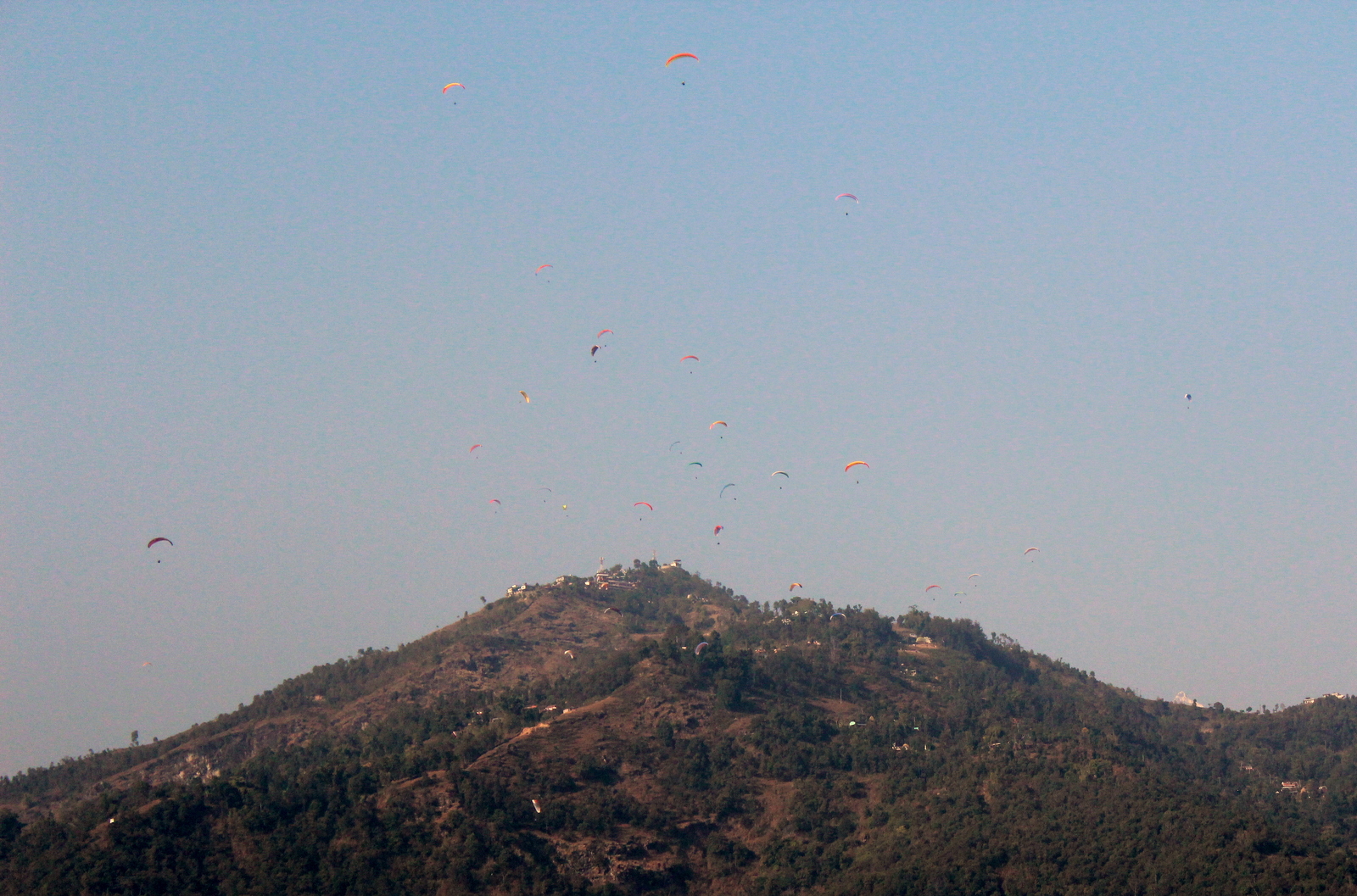
If you look high over the hills to the north of Pokhara, you see what appear to be dozens of birds of prey. Swooping and drifting in the wind, they’re like vultures circling the terrain below. It’s only upon closer inspection you notice the colourful parachutes and arched openness of what can only be a group of paragliders.

1-IMG_2868

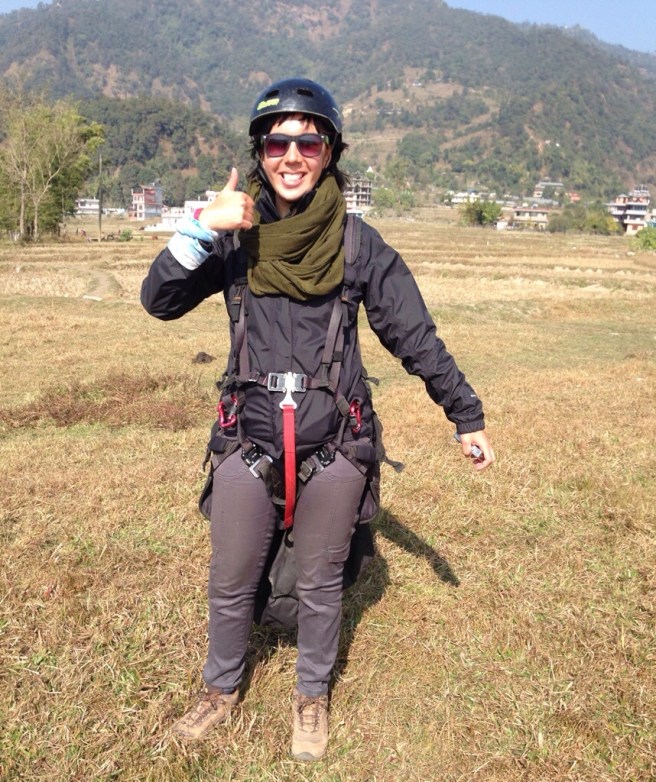
On Monday morning, one of them was me.

Here I am! This was technically taken after landing, but you get the gist of it..

I’d read about paragliding opportunities all over Nepal, but Pokhara seemed like the right place at the right time. I’d met a handful of fellow travellers who had paraglided here, and they had all told me about the awesome feeling that comes with soaring amongst the Annapurna Himalayan Range. It doesn’t hurt that Pokhara is listed as one of the best places on the planet to paraglide, either.

So I signed up for flight: December 30 at 11:30 a.m. Nearing the end of 2013, I figured it was good to round off the year with a new and exciting experience.

At shortly after 11 a.m. that day, myself and three other paragliders made our way up to the launching area in the back of a large jeep. The views of the mountains and down onto the sprawling reaches of Pokhara were stunning from the open back of the jeep, and I couldn’t wait to see the same sights from thousands of feet, floating freely through the Himalayan thermals.

One of my fellow paragliders, just before I took off

The paragliding trips all take off from the town of Sarangkot, 1,450 metres up. Each company has its own private take off spot, each lined up next to one another along the steep mountainside.

Sunrise Paragliding's take off area.
Sunrise Paragliding’s take off area.

My pilot, Laxman, got me buckled into the harness.

Laxman! He has been paragliding for seven years and goes up with tourists three times a day.

He then instructed me how to take off: walk, walk, walk, ruuuuuuuun! The actual take off process really didn’t last that long, and is not a hugely fear-inducing activity. Prior to my trip, I had pictured something more like the Lukla airport: a steep runway area, a fast run and a leap off a cliff. This was much more tame. After a few seconds, the wind takes over, and filled our creamsicle-coloured parachute, carrying Laxman and I up off the ground.

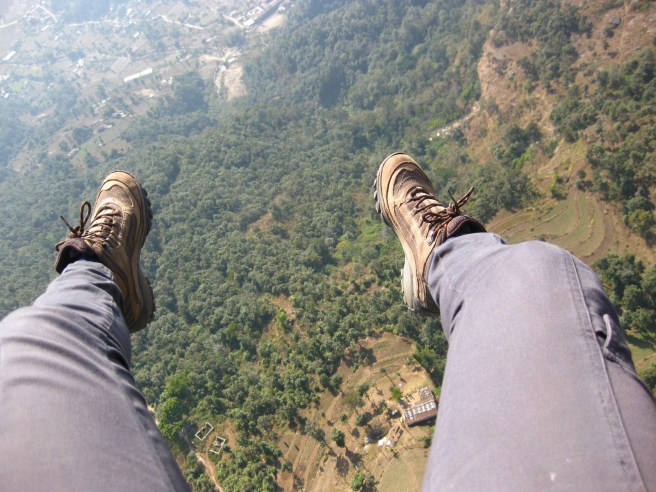
Soon we were high above the take off area, my feet dangling beneath my seat in the harness.

Long way down!
Long way down!

The view was spectacular. On one side, breathtaking views of the Annapurna Range: Dhaulagiri, Machapuchare and Annapurna II, lined up across the horizon, their sides only slightly obscured by a few wisps of cumulus cloud. The proximity of Pokhara to such clear Himalayan views is impressive and humbling: a toy-sized city stretched out beneath their magnitude. In the other direction was the ravishing blue of the Phewa Tal, a breeze creating a surface of sparkling diamonds. The silhouette of the World Peace Pagoda on the distant hillside; the city; the distinctive plots of nearby homes and farms. All was visible with such a sharp clarity.

18-IMG_6668

13-IMG_6661

The actual experience of paragliding involves a series of soft turns, following the air flow as it pushes you up and gently drives you down. The movements of the paraglider (thanks to Laxman’s expertise) are graceful and calculated.

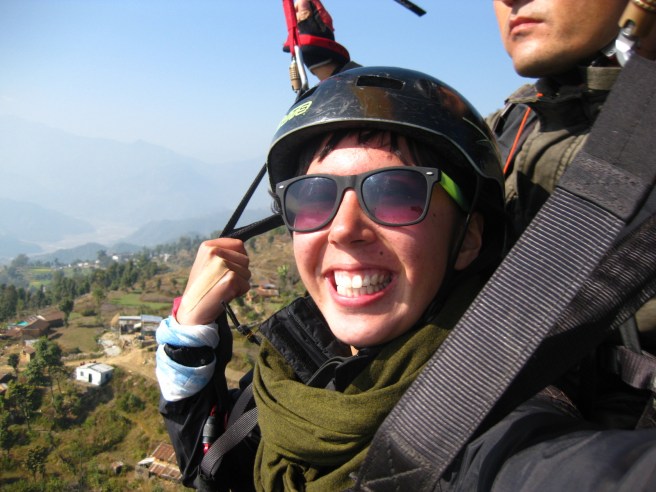
Marlon had lent me her small point and shoot camera (with wrist strap!) for the ride, and I while up in the air I practiced the ancient Nepalese art form of the “selfie.” Maybe you’ve heard of it?

07-IMG_6653

?????????????????????????????????????????????????????????????????????????

Overall, an incredible experience, and another check off my bucket list!