Cooking lessons in Kathmandu

(Look! Hilary Makes is still a food blog sometimes!)

When it comes to travelling, one of my favourite things to do is discover the unique food and drink that make up the meals of those places. Here in Nepal, that means two main dishes: dal bhat and momos.

I have eaten countless amounts of both since the beginning of November, both as trekking fare and as dishes I find myself craving while in the city.

A momo stop along the Everest Base Camp trek.

Let’s talk about dal bhat first. “Dal bhat” translates literally to mean “lentils” and “boiled rice.” When it comes to this dish, you never have the same meal twice. There are so man components to dal bhat, and as such, there seems to be endless combinations of the food-things you will find on your plate. First, there’s the basic vegetarian versus non-vegetarian option. The latter comes with a small meat curry, where the protein can range from chicken to buff to mutton. Then there’s the vegetable curry, which usually has potatoes and always mixed greens. From there, the seasonal vegetables take over, and I’ve found anything from peas to carrots to tomatoes in my curry.

Yummy vegetable curry

It’s a fun mystery awaiting your plate. There’s also the consistent parts of dal bhat – a bowl of lentil soup (pressure cooked with turmeric and a garlic-ginger paste) and a whole pile (and I mean just a tonne) of steaming rice. Not for the faint of heart are the refills that come for all of the above. For the record, your answer to the question ‘would you like some more?’ should always be yes. Besides, it’s like our trekking guide, Gopal, puts it: “dal bhat power, 24 hours.” (Fun fact: the best dal bhat I have had so far was at a side-of-the-road, 11 p.m. dinner stop in the middle of a 12-hour bus ride to Janakpur).

Then there are the momos. The term “momo” already means a number of different things to me – it’s the name of Andrew Knapp’s world  famous border collie, as well as the Japanese word for “peach.” And now, it also means heavenly stuffed dumplings. Like dal bhat, the combinations are aplenty. There’s the savoury momos, with meat, mixed vegetables, potato and cheese (what I order when I am missing perogies) that can be served either steamed or fried. Then there’s the ridiculous dessert momos, the ones that make me giggle and gasp inquisitively when I see then on menus. The Snickers momos and the Mars momos, as well as other ones filled with any sort of chocolate (I most certainly intend to try these at least once before I leave Nepal).

The best momos I’ve had so far were bought in Bhaktapur, from a giant steamer outside a local restaurant. They were filled with seasoned pork, and, since I would always get them to go, would be plopped delicately into a small bag, the steam glossing out the plastic. A squirt of chili sauce for seasoning, and I was off, left to my own devices to discover a new part of the town in which I would eat my bag of dumplings and people watch. I would normally pop each morsel into my mouth in one bite, avoiding the rush of meat juices from running down my fingers.

IMG_2113

Coming to Nepal, I knew I wanted to learn how to make both dal bhat and momos. So earlier this month I took a cooking class from a Nepalese company called Social Tours, the group recommended by my travel bible, AKA Lonely Planet. I packed my camera and notebook in the morning, stomach growling in anticipation of my full-day of cooking lessons.

First up were the momos. There were two other Canadians, Ryan and Carmen, in the class, so alongside our instructor Sakun, I was in good company. Part of the cooking lessons experience was getting to go to a local market to choose and buy our ingredients. On we went down one of Thamel’s twisting alleyways, to a hole-in-the-wall shop.
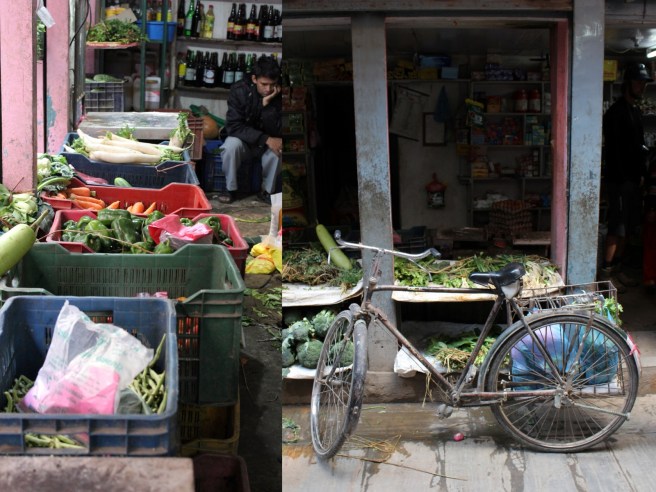
We measured handfuls of red onions, cabbage, green onion, tomatoes, garlic, cilantro… cramming them into a fabric bag Sakun had brought along. I also picked up some spices to use at home – a 200 gram bag cost about 50 cents Canadian, and the deal was too good to refuse.
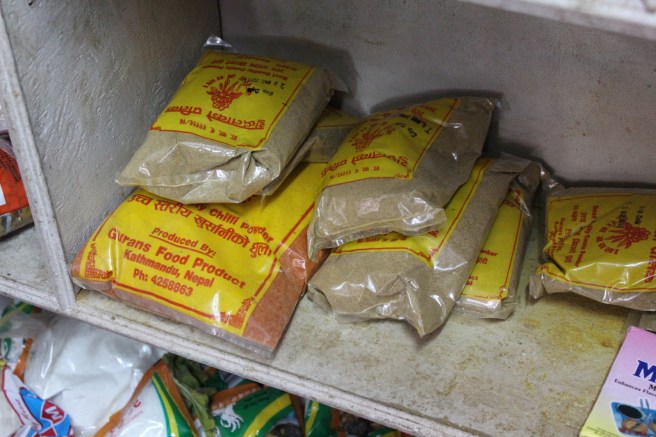
IMG_2058

I also bought a box of special momo masala spice, for the momo-making parties I’m already anticipating for the near future (like a sushi party, everyone brings a filling!).

Ryan, Carmen and I quickly learned the secret to a good mixed vegetable momo is to make sure everything is cut extra, extra finely. Sakun sent us each back to our cutting boards a number of times, demanding with a laugh that we chop things just a little more. I didn’t mind, though (then again, I wasn’t cutting the onions…), since I realized how much I’ve missed cooking since I started travelling. It felt good to be in a kitchen and making food again.

?????????????????????????????????????????????????????????????????????????

Once our chopping satisfied master chef Sakun, it was time to make and roll out the momo dough. Six cups of flour and a cup-and-a-half of water was what was needed to make the casings for dozens of momos, and leftover dough was used to make chapati, another Nepali roti (bread). We took marble-sized pieces of dough and rolled it in our palms as though forming meatballs. Each ball was then rolled flat with a tiny rolling pin, and tossed onto a central plate for stuffing.

Carmen and Ryan learning how to perfectly crimp the momos

That was the fun/messy/tough part. Sakun patiently showed us how to make the crescent-shaped momos by crimping one side of the dough while holding in the filling with the thumb of our opposite hand. We also made the round momos (far more difficult), with the cute pinched together tops. Usually the different shapes are used to indicate whether a momo is vegetarian or not.

Predictably, eating remains my favourite part of momos. And eat we did. The best part of the meal was that we got to share it with the other Social Tours staff members, and watch their reactions as they took the first bites of our freshly made momos.
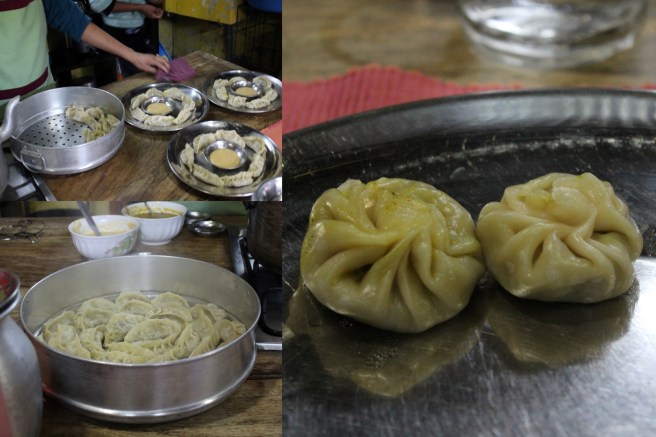
The finished product!

After a short lunchtime food coma break, it was time to make dal bhat. Sakun and I took another trip to the market, this time picking up potatoes, green beans, carrots and spinach. One of the essentials of dal bhat is the spice palette, and Sakun had a few jars of turmeric (for the dal), chili powder, cumin, coriander and fenugreek (I had never heard of this before) to season the different dishes. The dal bhat vegetables required considerably less chopping than the momos, and the entire process took about an hour.

Dal bhat ingredients

In the end, the different dishes were the dal, the bhat, tarkari (vegetable curry), for saag (curried spinach), and achar (“pickle” made of tomatoes and delicious fresh green chillies). You’re left with a whole assortment of flavours and plates, all of which combine to make the delicious Nepalese speciality. I was still full from momos, but went back for seconds (remember the rule: always say ‘yes’ to more dal bhat)

All the components of dal bhat, together as one (starting in bottom right and going clockwise, there's the dal, vegetable curry, curried spinach, pickle, and carrots)
All the components of dal bhat, together as one (starting in bottom right and going clockwise, there’s the dal, vegetable curry, curried spinach, achar, and carrots)
Dinnertime! Happy as a clam.
Dal bhat
Dal bhat

I have the recipes for a variety of momos and the dal bhat now, and I can’t wait to re-create both when I get home!

A political portal to the world

(Just the first in a series of posts and retrospectives written and rewritten during and post trek)

A small corner of window at a teahouse in Dzongla has become an unconventional gathering point. The patch of window is positioned right by the teahouse’s front desk, and a large crack in the glass has been covered with faded brown duct tape to keep out the wind.

For now, this single window looks out not only onto the mountains, but onto a changing political scene in Nepal.

This window spot is where a handful of Nepalese sherpas, guides and porters, are getting their election news. It’s November 20, a day after the country’s national election, one that has been delayed several times over the past year. Some background: it has not even been a decade since Nepal became a parliamentary republic, having abolished the powers of the country’s long-time monarchy. Since the first Constituent Assembly elections held in 2008, the country has been repeatedly attempting and failing to write a new constitution.

With this most recent election, it will take days for the ballots to be counted and collected, both by computer and by hand.

But back to that corner patch of window.

IMG_1843

Dzongla is located at 4,830 metres, and that patch of glass is the only place in the teahouse that gets cell phone reception. The election results are streaming through a cell phone that’s been put on speaker. It’s a Nepalese friend of the bunch relaying information from Kathmandu. It will be days before the Nepali Congress party (one of three main parties in Nepal, where there are a staggering 50+ political parties) is declared the winner, earning 105 out of the country’s 240 first-past-the-post seats. The former, post-civil war ruling party, the Maoist Communist Party of Nepal, saw its power wane, and ended up in third place, much to the thrill of my trekking guide, Gopal.

Here in the Himalayas, the Nepali Congress party is the most popular, with people telling me they put more focus on important priorities like building hydro-electric dams (much of the power in the upper altitudes comes from unsustainable kerosene, when there are multiple raging rivers whose powers could be harnessed) and increased access to clean water. One night in a town called Lobuche, a pro-Maoist guide was talking loudly about the party to his German trekking group. The tension in the room could have been cut with a knife. I was fascinated.

While lacking news and updates of my own country’s politics (wireless is possible while trekking to base camp, but it’s often expensive because it’s through a satellite connection), I became immersed and intrigued by the Nepalese political system.

Outside of this political-portal-in-the-form-of-teahouse-window, every night the guides and porters sit around the different teahouse stoves to discuss the day’s ongoings. I don’t understand the language, but I recognize the names of the political parties and the body language that follows the mention of each. I identify with the draw and appeal of ignited discussion, the dragging over of a plastic chair to join the conversation. Will this new Constituent Assembly be able to finally draft a constitution? Or will next year’s trekkers be hearing similar sentiments, more lost-in-translation political musings?

Time will tell, and I’ll be following from home.

I am both grateful and a little sad to have not been in Kathmandu during election day and the weeks leading up to it. Sad in a curious journalist sense. Grateful in the sense that the entire capital was virtually shut down because of a city-wide bandh (strike), where shops, offices, and schools were closed. The morning we left for our trek, our van to the airport was stopped by the military in preparation for political demonstrations later that day. Over the following week-and-a-half, those political protests grew violent, and people were injured. We take our peaceful political system in Canada for granted in so many ways. But to be fair to Nepal, at least national elections are something that everyone talks about, cares about, and feels invested in. Sure the political system here is disorderly, but maybe disillusionment and low political turnout requires a systematic reform just as much as chaos does.

A paper making lesson in Bhaktapur

Selecting amongst Newari handiworks in Bhaktapur is a difficult task. The village in the Kathmandu Valley is known as the cultural capital of Nepal, and its streets and squares are teeming with vendors selling and creating the most intricately designed woodwork and pottery. Bronze singing bowls hum from storefronts and pashminas and cotton change purses blow in the breeze like flags. When it comes to the craftmanship, I admire it all.

?????????????????????????????????????????????????????????????????????????

But in true Hilary form, the paper was what I fell in love with the most. Anyone who knows me even a little bit knows my affinity for paper, colours, and paper crafts. Nepal is famous for making its own special kind of paper called “lokta.” That’s the name for the grassy shrub that grows in the low altitudes of the Himalayas, and its bark is used in the paper pulp. Research is currently being done to try and connect the similarities between the lokta plant and the material used for papyrus paper in Ancient Egypt. The Kathmandu Valley, and particularly Bhaktapur, is known for producing lokta, and there are factories in the town that produce the paper from plant to product, right on site.

One of the factories to do this is part of The Peacock Shop, found in close proximity to Bhaktapur’s famous wooden peacock window.

Heading to The Peacock Shop at the end of my first day in town, I met Suyog, the 23-year-old son whose family owns the factory and paper shop. He was kind enough to give me a tour and, since a paper factory is kind of the ultimate visual experience, I thought I’d invite you along for the ride. This is my first experiment with multimedia while travelling, using a bunch of tools I’m not used to, so excuse some of the quality issues!

I went back to The Peacock Shop the next day and bought a whole bunch of one-of-a-kind items – cards with a local flair (the red flag-like feature is meant to represent the local sari, and the yellow kites symbolize good health in Nepal), and incredible stationary sets.

Some of the beautiful greeting cards from The Peacock Shop

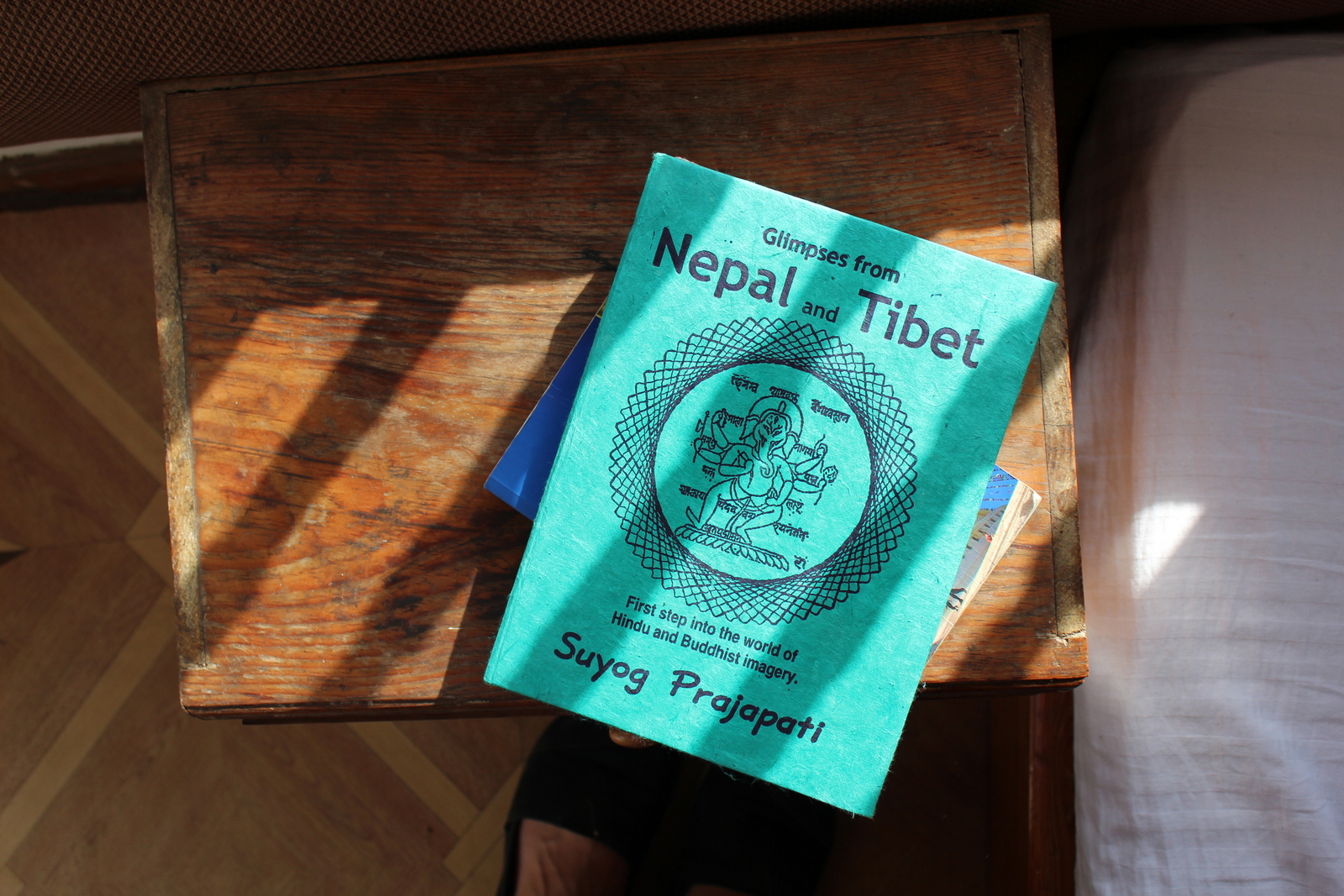
I also got an introduction to Buddhism and Hinduism book that Suyog wrote and printed when he was 17. I have been expanding my knowledge of the iconography throughout this entire trip, and hope this book will further enhance my learning and appreciation of spirituality in Nepal!

IMG_2179

Day and night

Nepal wakes up early.

Or early by most Western standards, anyways. It’s 6:23 a.m. and the red cobblestone streets of Bhaktapur – a medieval municipality east of Kathmandu where I’m spending the next few days – are bustling with activity. The taxi honks that populate the streets of the country’s capital are absent here, but the sound of motorbikes and dog barks allude no one or no place.

The view from my guesthouse window.

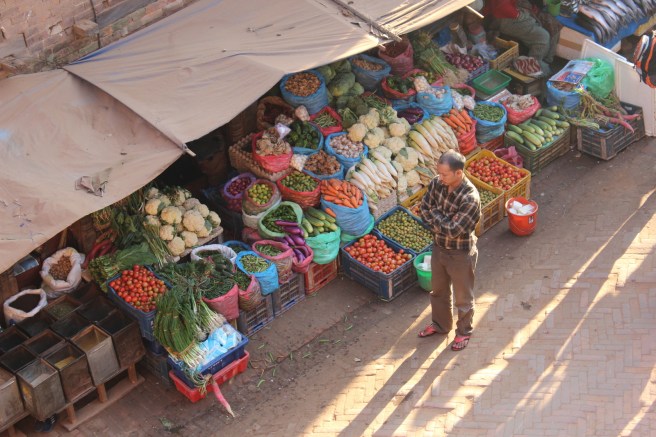
The smell of cooking oil is drifting up three levels from the street. Despite the windows being closed, its scent is filling my guesthouse room, where I sit on the bed, face lit only by the screen of my netbook. Behind me, the curtain is growing brighter by the minute, someone pressing the brightness button on the day at hand. Down below, fruit carts hobble over uneven brick, and a vegetable vendor sells to early passersby. The fish monger has yet to arrive, and for a few more moments, the area in front of his table remains free from the slippery blood slick that almost claimed my grace yesterday.

IMG_2104

IMG_2107

It’s almost winter, and days are short in the Kathmandu Valley. The sun is setting at around 5:30 p.m., blanketing both Kathmandu and Bhaktapur in a thick darkness. In Canada after dusk, it doesn’t get dark, not truly. Our streetlights, houselights, shop lights, business lights, all of the lights (as one may say) remain on, sometimes, absurdly, throughout the night. I never realized how much electricity impacted my perception of the night-time landscape.

Not so, in Nepal.

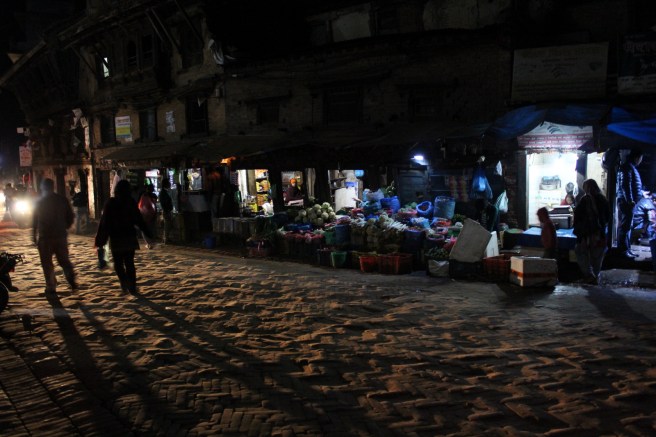
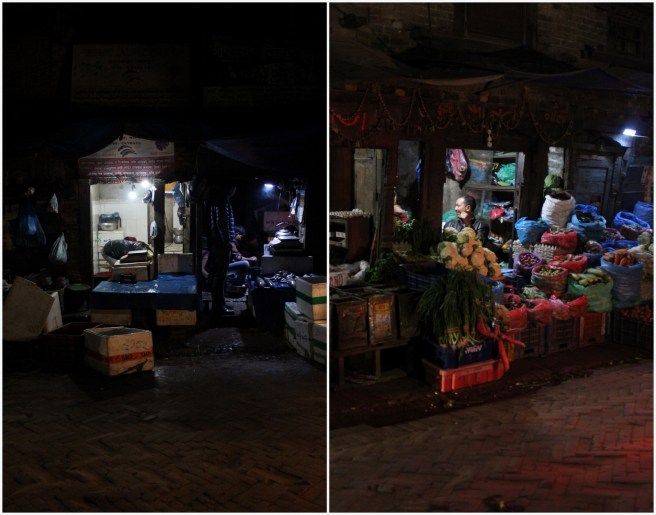
Those same storefronts by my guesthouse, by the light of darkness.

Rolling power outages around the city mean many businesses are lit by candlelight or, like the vegetable vendor across the street, a single light bulb once darkness falls. The effort of that small bit of electricity alone is accompanied by the churning and rumbling of a generator. I take our unprejudiced, unlimited access to hydro, both day and night, completely for granted.

?????????????????????????????????????????????????????????????????????????

On my first night in Bhaktapur, I arranged to have supper with a new friend at 6 p.m. We choose to meet in front of one of the temples in the town’s Durbar Square, a main gathering point where we had both been earlier that day. I was exploring a local paper  factory (more to come) when night fell, and geographic disorientation took heed. All the identifying marks you subconsciously and consciously bookmark disappear as soon as it gets dark. That momo seller on the corner, the craft tables, the King Curd (a Bhaktapur specialty…like a tangy cottage cheese made with buffalo milk. So yummy) shop – all had shut their doors for the day, taking a magic eraser to my mental map.

A street food vendor works by the light of a small generator.

I found my way eventually, carrying my headlamp for both directional purposes and to make myself known to the motorbikers who still roamed the streets.

Outside the heritage portion of Bhaktapur (a portion of about 12,000 Newari-style homes), activity remained a little more vibrant. In the storefronts that were still open, men and woman huddled around the single light source, sitting on the stairs or on the floor, talking or playing chess. I guess you get used to the inevitable darkness of night as a guest at the dinner table.

I’m not sure if it’s because the power outages and early evenings limit work from progressing past the supper time mark (I have a feeling it does not, because Nepalese people are some of the hardest workers I’ve ever met), but it seems like because of, or in spite of it, they embrace every little bit of daylight. Early evening and a lack of power can dictate your schedule, and it feels natural to go to sleep a few hours after dusk, waking up with the sun and the literal rooster crows.

Evening blogging, courtesy of battery power and headlamp light.

PS: I am in the midst of attempting to write about 10 million blog posts summarizing the incredible experience that was my Everest Base Camp trek. In the meantime, I will be continuing to blog about other things, with trekking posts hopefully scattered throughout.